

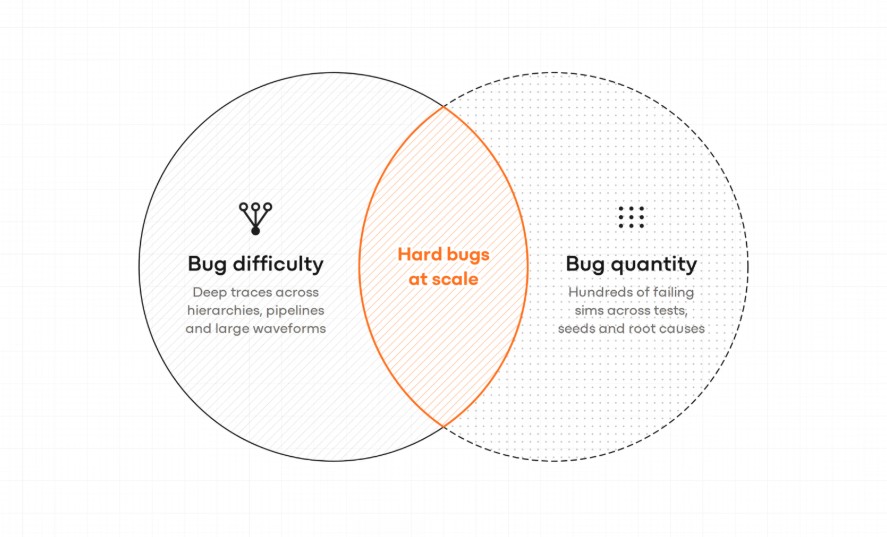
As semiconductor designs grow larger, debugging is becoming increasingly difficult to scale. ChipAgents argues that autonomous root cause analysis, or RCA, must address not only difficult individual bugs but also the hundreds of failures that can emerge from large verification regressions. The company proposes an AI-native workflow that treats debugging as an orchestration problem rather than assigning an independent agent to every failure.
ChipAgents identifies two dimensions of debugging complexity: bug difficulty and bug quantity. Difficult bugs may require tracing signals through deep hierarchies, long pipelines, large waveforms, and interacting components. Meanwhile, regressions can produce hundreds of failures across different tests and simulation seeds. Many apparently different failures may originate from the same underlying problem.
To reduce this workload, ChipAgents RCA Triage adds intelligent binning after conventional failure grouping. The system looks beyond matching log signatures to identify failures that are likely to share a root cause. Instead of investigating every failed simulation separately, it reduces them to a smaller number of meaningful groups.
The system also limits expensive simulation reruns. Rather than generating waveforms for every failure, it selects a minimum set of witness simulations that can provide enough information to explain each failure group. These simulations are rerun with waveform dumping enabled and passed to autonomous RCA.
The RCA system then investigates causes, proposes fixes, and verifies them. Successful fixes and confidence scores help determine whether the design is ready for a final regression. This creates a workflow spanning regression, intelligent binning, witness selection, waveform generation, autonomous RCA, fixes, verification, and final regression.
ChipAgents also emphasizes economics. Multi-agent systems can improve debugging accuracy but consume additional resources. The goal is therefore not simply greater automation, but autonomous debugging that can reliably prioritize investigations and control compute costs across commercial-scale semiconductor development.
