

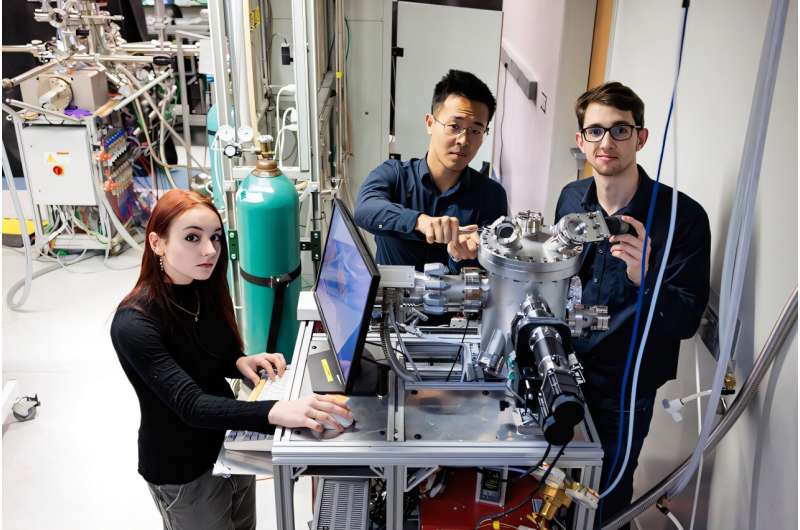
A research team from the University of Chicago Pritzker School of Molecular Engineering (UChicago PME) has developed a “self-driving” laboratory platform that uses robotics and machine learning to optimize the growth of thin films via physical vapor deposition (PVD), tells Tech Xplore. Traditionally, engineers tweak parameters such as substrate temperature, gas composition, and deposition time by hand, contend with hidden factors (substrate variability, trace gases), and face slow iteration cycles. The new system begins each run by depositing a calibration layer to account for hidden variation, letting the machine-learning model learn the specific conditions of that experiment. The platform then predicts experiment settings, synthesizes the film, measures its properties, and loops until the desired outcome is reached. The ability to quantify previously “noisy” hidden variables gives the system a big edge in reproducibility.
For engineers, this means the barrier between design and realized material is shrinking: instead of weeks or months of manual tuning, the autonomous lab can hit the target much faster. What stands out is how the system deals with real-world variation rather than assuming every run is identical. By modeling those differences explicitly (via the calibration layer), the algorithm gains robustness. The article notes that this is not simply automation but an integration of robotics, real-time measurement, feedback control, and machine learning, essentially a closed-loop material discovery engine.
The implications for engineering are significant: faster materials discovery, more consistent thin-film fabrication, lower human overhead, and fewer failed experimental runs. For domains such as electronics, optics, or quantum materials—where thin films are critical—this approach could reshape workflows. One caution remains: while the lab can optimize within the known parameter space, truly novel materials or uncharted chemistries still require human creativity and insight. Nonetheless, the article argues that combining humans and autonomous systems will shift engineering practice toward higher-throughput, higher-precision workflows.
