

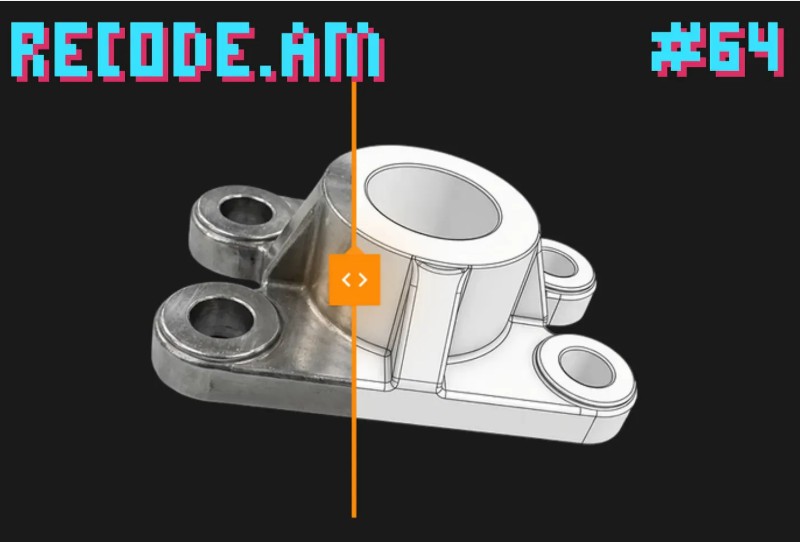
Most physical parts used in factories do not have corresponding editable CAD models. Backflip wants to change that with an AI system that converts scans, meshes, STL files, and other existing geometry into parametric CAD models that engineers can modify, tells The 3D Printing Journal.
Backflip was founded by Greg Mark, co-founder and former CEO of Markforged. The company initially developed text-to-3D technology but shifted toward industrial applications after recognizing a larger opportunity in reverse engineering. Its early conversion system could reproduce geometry but did not generate models that behaved like engineer-created CAD. Backflip subsequently rebuilt its technology around constraints and editable features.
The current workflow is straightforward. A user uploads a scan or mesh and starts the conversion. Instead of returning a static solid, Backflip generates a feature tree with editable sketches and relationships between features. Changing the diameter of one hole, for example, can automatically update related holes. The system produces four reconstruction alternatives, allowing users to select the most appropriate model before transferring it to Autodesk Fusion.
Backflip offers two processing modes. Fast prioritizes speed and lower cost, while Thinking uses an AI agent loop to repeatedly refine geometry until dimensions align. Mark says about 40% of conversions require no additional work, while another 40% can eliminate roughly 80% of manual modeling effort. Some complex parts remain beyond the system’s capabilities.
Cost could be the technology’s biggest advantage. According to Mark, conventional reverse engineering can cost around $1,500 per part. Backflip charges about $10 in Thinking mode and $2 in Fast mode.
That difference could make digitizing entire inventories economically feasible. Factories could convert legacy components, tooling, and fixtures into editable digital models, creating virtual parts libraries for 3D printing, CNC machining, injection molding, or casting.
Backflip’s broader ambition is to make CAD accessible beyond trained designers. By simplifying the conversion and editing process, the company sees AI-generated parametric models becoming a foundation for more flexible, on-demand manufacturing.
