

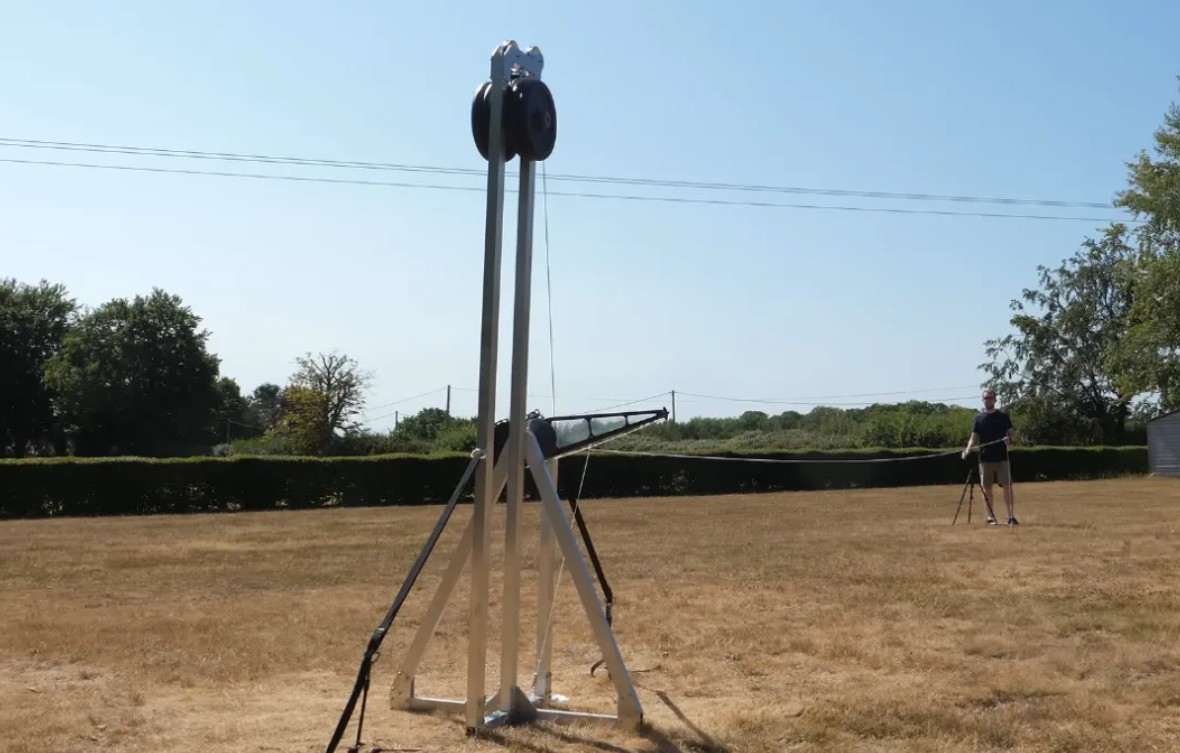
Aerospace engineer and YouTuber Tom Stanton has built a mechanical trebuchet capable of launching a projectile faster than the speed of sound. His backyard experiment reached 776 mph, exceeding the roughly 767 mph threshold required to produce a sonic boom. The achievement required Stanton to rethink the mechanics of a weapon whose basic operating principle dates back centuries, tells Popular Science.
Traditional trebuchets use a falling counterweight to rotate a long beam, which accelerates a sling carrying a projectile. Although historical versions could have beams around 50 feet long, their performance was ultimately limited by gravity. Increasing projectile velocity beyond that limit typically requires additional energy sources, such as elastic bands or other tension mechanisms. Stanton instead wanted to achieve supersonic speed using only a falling weight.
To accomplish this, he separated the counterweight from direct coupling with the throwing arm and introduced a rope-based 3:1 pulley system. The arrangement allowed the counterweight mechanism to accelerate the arm more effectively. He also shortened the throwing arm and used a sling approximately twice the conventional length. This allowed the sling to rotate several times, accumulating additional momentum before releasing the projectile.
Reaching the target required extensive experimentation. Stanton strengthened the falling pulley assembly to withstand the substantial forces generated during operation and used a carbon-fiber frame. Eventually, the trebuchet produced the distinctive crack associated with supersonic motion.
Measurements confirmed the result. The arm reached 2,342 rpm, while the projectile covered 6.36 feet in just 5.6 milliseconds. That translated into a final speed of 776 mph. Remarkably, the trebuchet survived the test despite the intense mechanical loads. Stanton’s project demonstrates how careful changes in mechanical advantage, geometry, and energy transfer can push a centuries-old gravity-powered machine into the supersonic regime.
