

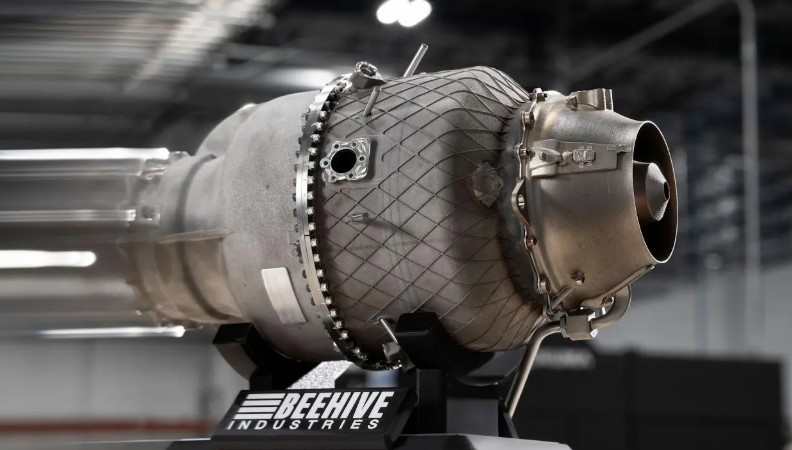
Beehive Industries is moving its 3D-printed jet engines from development into full-scale production, demonstrating how additive manufacturing can reshape propulsion system design and manufacturing. The Denver-based company has developed engines aimed primarily at unmanned aerial systems and other defense applications where rapid production, performance, and supply-chain flexibility are increasingly important, tells Forbes.com.
Rather than using additive manufacturing simply to reproduce conventionally manufactured components, Beehive designs engines around the capabilities of metal 3D printing. This approach allows engineers to consolidate assemblies that would traditionally require numerous individual components, fasteners, welds, and manufacturing operations. Fewer parts can simplify assembly, reduce potential failure points, and shorten production timelines.
Beehive controls much of the development process internally, including engineering, simulation, additive manufacturing, machining, inspection, assembly, and testing. This vertically integrated approach enables engineers to move quickly between design changes and physical validation. Additive manufacturing also allows the company to produce geometries, including complex internal passages, that would be difficult or impossible to manufacture using conventional methods.
The company’s engines include the 100-pound-thrust Frenzy and the larger 500-pound-thrust Rampart. Beehive has designed its manufacturing strategy to support production at significantly greater volumes than are typical for metal additive manufacturing.
Scaling remains one of the industry’s biggest challenges. Producing repeatable parts requires tight control of printers, materials, process parameters, post-processing, machining, and quality assurance. Beehive addresses this by treating additive manufacturing as part of an integrated production system rather than an isolated printing operation.
The company’s expansion also reflects growing demand for lower-cost propulsion systems for autonomous aircraft and defense platforms. By combining design, simulation, metal 3D printing, and testing under one organization, Beehive aims to shorten the traditional aerospace development cycle while demonstrating that additive manufacturing can advance from specialized prototyping to repeatable production of complete propulsion systems.
