

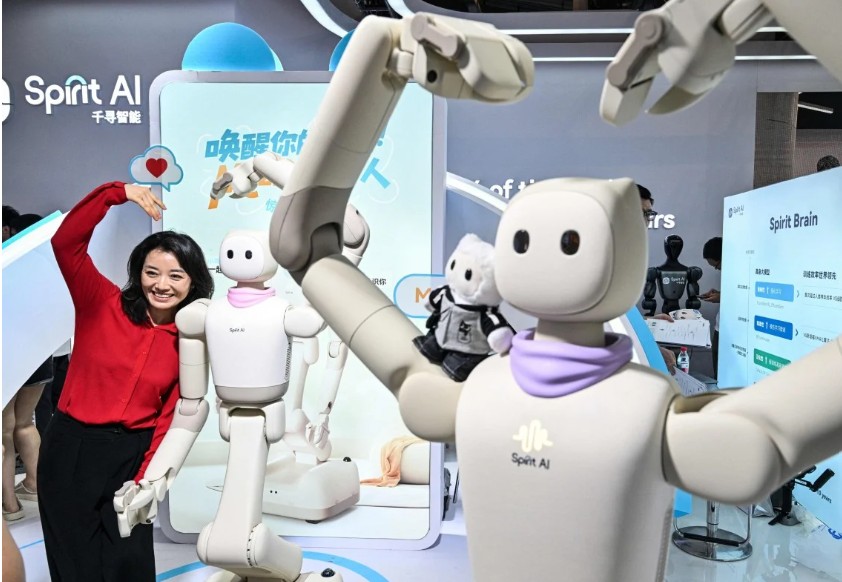
A Chinese physical AI startup has found itself at the center of a debate after questions emerged over its performance on a global robotics benchmark that placed it ahead of Nvidia. The controversy reflects the increasing importance of evaluation benchmarks as embodied AI, or physical AI, becomes the next major frontier in artificial intelligence. Unlike large language models that generate text, physical AI systems are designed to perceive, reason, and interact with the real world through robots and autonomous machines, tells this South China Morning Post article.
The company, Spirit AI, announced that its Spirit v1.6 foundation model had achieved the highest score on the RoboArena leaderboard, surpassing Nvidia’s Cosmos3-Nano-Policy model. RoboArena is a benchmark co-developed by Nvidia, Stanford University, and the University of California, Berkeley to measure how effectively robot foundation models translate decisions into real-world actions. The announcement attracted widespread attention because it marked the first time a Chinese model had reached the top of the ranking.
However, the result also prompted skepticism within the AI community. Critics questioned whether the benchmark had been manipulated or whether the evaluation process had been applied consistently. The debate highlights a broader issue facing the AI industry: benchmarks are increasingly influential in shaping public perception, investment, and commercial credibility, making transparency in testing methodologies essential. At the time of the report, no conclusive evidence had been presented publicly to prove deliberate manipulation, and the discussion remained focused on the need for independent verification and clearer evaluation standards.
Regardless of the outcome, the episode underscores the rapid progress of Chinese companies in embodied AI. The competition has shifted beyond generative AI toward robots capable of performing physical tasks in factories, warehouses, and homes. Nvidia continues to invest heavily in physical AI platforms and partnerships, while Chinese startups are advancing their own foundation models for robotics despite ongoing technology restrictions.
The controversy also illustrates that leadership in AI is no longer determined solely by model capabilities. Reliable benchmarking, transparent evaluation, and reproducible results are becoming equally important as governments, researchers, and companies race to define the next generation of intelligent machines. As physical AI matures, trusted performance standards will play a critical role in distinguishing genuine technological advances from headline-grabbing claims.
