

Since its launch in 2018, MLPerf, run by MLCommons, has served as a key benchmark suite for measuring how quickly systems can train specified AI models on defined datasets. Participants submit clusters of CPUs, GPUs, and optimized software twice a year to see who can hit the target accuracy the fastest, says IEEE Spectrum.
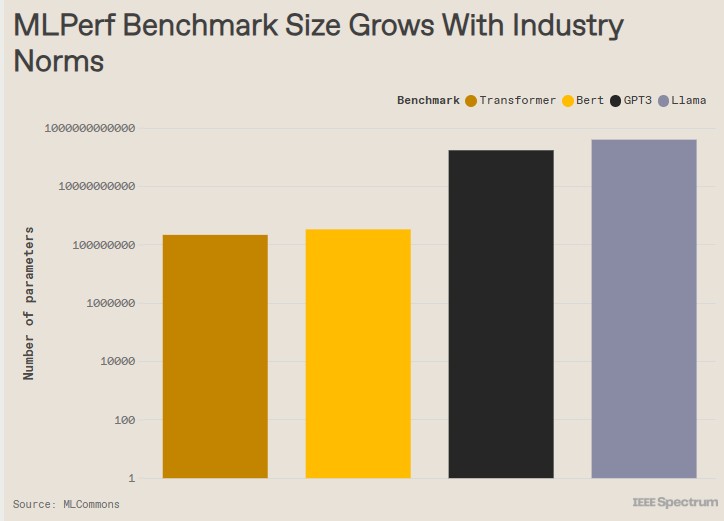
The benchmark results show that although hardware has improved dramatically over the years, such as multiple generations of new GPUs from NVIDIA, the tasks themselves have also become tougher. Benchmarks are updated to reflect industry-relevant workloads, meaning the “goalposts” keep moving. As a result, training times haven’t necessarily dropped steadily: gains from hardware are often offset by increased model size and complexity.
One notable trend: model growth (in parameters and dataset size) is outpacing hardware improvements. That means for some benchmark tasks, the fastest time for training actually increases before the next hardware iteration brings time down again. The cycle: bigger model → longer training time → hardware upgrade → shorter time → repeat.
Designing AI-training systems isn’t just about faster chips or more GPUs. It’s about architecture that handles scale, model complexity, system interconnects, and software-hardware co-optimization. The MLPerf data suggest investments should go beyond raw compute and into network fabrics, memory systems, and energy-efficient design.
The MLPerf trends indicate that AI training remains a moving target. Hardware upgrades matter, but so do smart design choices and scalable architectures if systems are to keep up with the expanding size and ambition of AI models. Engineers should take note: the benchmark isn’t static and neither can our infrastructure plans be.
