

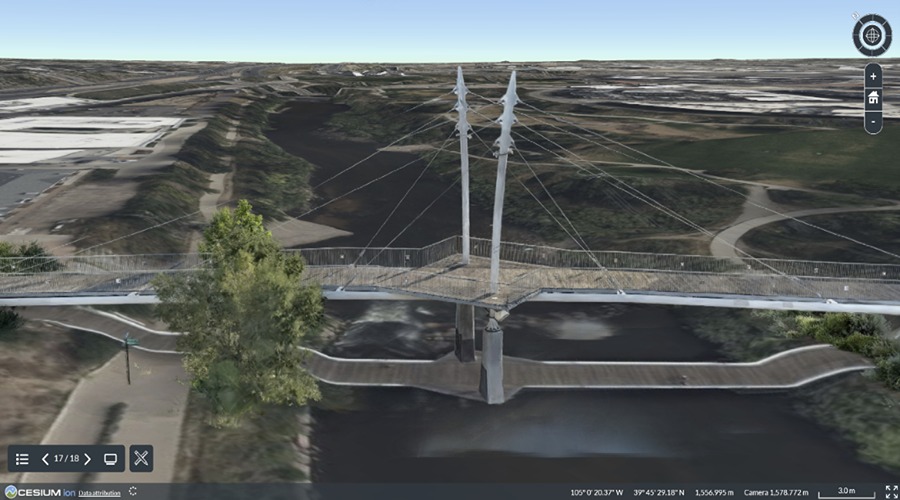
AMSTERDAM, Netherlands (Bentley Systems’ Year in Infrastructure 2025), Oct 16, 2025 – Bentley Systems has expanded its Cesium platform with new reality modeling and geospatial services. The updates support both built and natural environments. The new features improve project delivery and asset performance through 3D and location-based data analysis. Bentley also introduced an application in Cesium that helps infrastructure teams collaborate on projects.
“Our vision for infrastructure engineering is built on openness,” said Patrick Cozzi, Bentley’s chief platform officer. “With the integration of iTwin and Cesium capabilities, we are creating the open platform for the built and natural environment—providing all the necessary data for infrastructure professionals to design, build, and operate in a real-world context.”
Adding Reality Modeling and AI-Powered Analysis to Cesium
Bentley has integrated iTwin Capture into Cesium ion, creating an automated pipeline from data capture to geospatial visualization. iTwin Capture generates reality models from imagery and applies AI-based feature detection, while Cesium ion allows developers to create and host this content for 3D applications in the cloud.
The integration allows Cesium ion to create 3D visualizations like reality meshes, point clouds, and Gaussian splats from imagery using AI. By creating digital models of existing built and natural environments, the platform helps infrastructure teams make better decisions throughout the project lifecycle.
“Being able to generate photogrammetry, point clouds, and Gaussian splats as 3D Tiles from drone imagery, stream them seamlessly to the web, and analyze the point clouds is a major milestone,” said Osarodion Victory Igbinobaro, co-founder and CEO of AERO AI, a Cesium user. “This release brings end-to-end 3D reality modeling into one accessible, high-performance pipeline.”
The reality modeling capabilities in Cesium ion will be available before the end of 2025.
Enhancing Project Delivery and Asset Performance with Geospatial Context
Cesium capabilities are also enhancing Bentley’s product portfolio, bringing geospatial context to Bentley Open Applications and Bentley Infrastructure Cloud.
MicroStation 2025 introduces support for 3D Tiles through Cesium, allowing engineers to use 3D content such as Google photorealistic 3D Tiles and their own reality data in design projects. This integration reduces manual modeling of existing conditions, reduces project setup time, and helps teams focus on designing solutions. The same capabilities will be available in Bentley’s open applications built on MicroStation for roads, railways, and bridges.
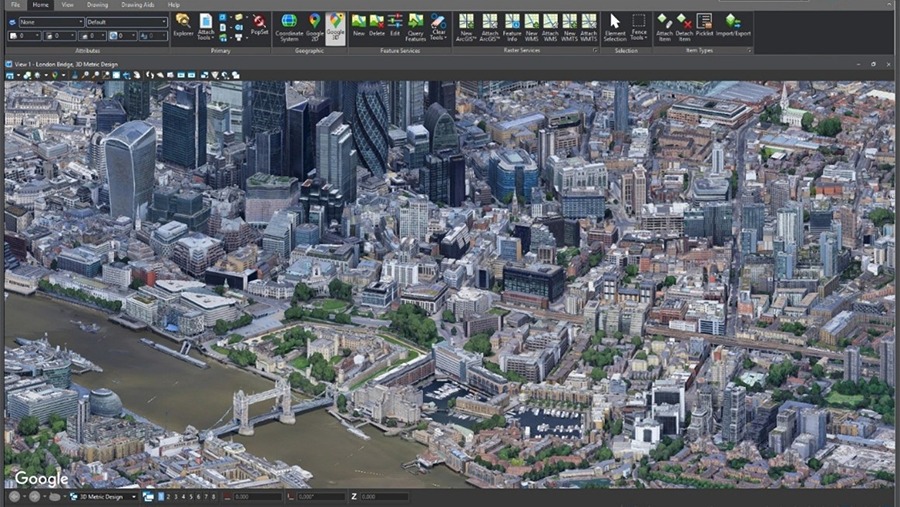
Cesium powers the geospatial experience in Bentley Infrastructure Cloud Connect, a platform that links project data and teams throughout the infrastructure lifecycle. Using Google Photorealistic 3D Tiles, users can navigate project sites and assets within Bentley Infrastructure Cloud.
Introducing iTwin Engage
Bentley also announced iTwin Engage, which enables infrastructure teams and their stakeholders to engage with digital twins of future and existing infrastructure assets.
iTwin Engage, powered by Cesium and game engine technology, enables users to create story-based visualizations of projects and assets. These experiences update automatically through a live connection to the digital twin, supporting design reviews, construction planning, and remote inspections.
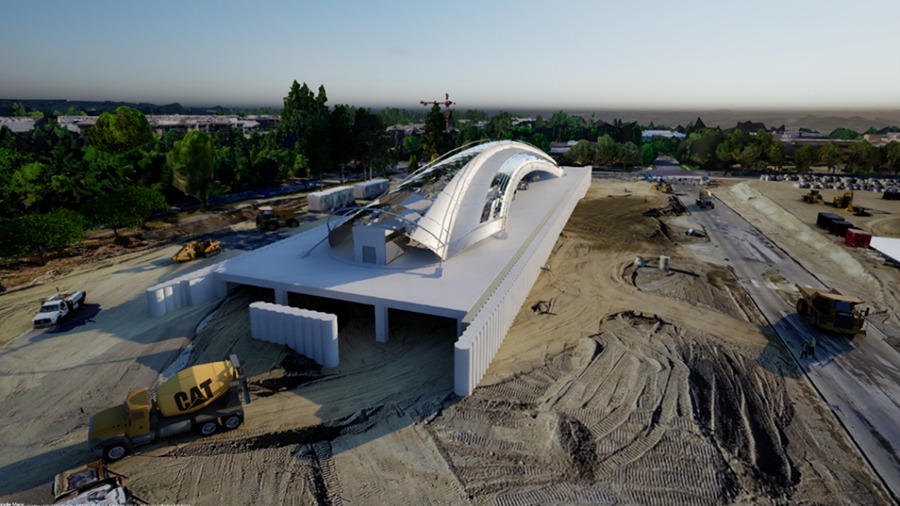
“The opportunity to present and communicate the project plan through iTwin Engage, in such an appealing manner, is fantastic,” said Simon Beards, principal planner, Laing O’Rourke, a participant in an early access program. “The greater the involvement the team has on the plan, the more likely there is a chance of success, as it supports a more collaborative way of engineering improvements.”
iTwin Engage will be in limited availability by the end of 2025.
Source: Bentley Systems
About Bentley Systems

Bentley Systems, founded in 1984, develops software for infrastructure engineering with a focus on supporting the design, construction, and operation of critical assets across transportation, water, energy, urban, and utility sectors. Its solutions are used globally by engineers, architects, constructors, and asset owners across various disciplines and project phases. The company provides integrated tools for modeling, simulation, project delivery, and asset performance management. A key area of focus is enabling digital twins to improve data integration and decision-making throughout the infrastructure lifecycle. Bentley’s software supports workflows across multiple engineering domains, helping users manage complexity and improve the reliability and resilience of infrastructure systems. Headquartered in Exton, PA, Bentley Systems operates in 40 countries with a workforce of around 5,500 employees. It serves approximately 41,000 customers in 190 countries. For the fiscal year ending December 31, 2024, the company reported revenues of about $1.4 billion, reflecting its continued role in advancing infrastructure technologies on a global scale.
About Cesium

Cesium is a Philadelphia-based company that provides an open platform for 3D geospatial applications. Its services include 3D visualization, data tiling, content hosting, and analytics. The company’s technology supports industries such as aerospace, infrastructure, smart cities, real estate, and geospatial analysis. Cesium’s origins trace back to 2011, when its core product, CesiumJS, was developed under Analytical Graphics Inc. The company became independent in 2019 and continues to advance tools that bring data into interactive 3D environments. Cesium’s estimated annual revenue is about $7.4M.
