

Bentley engineers are testing how AI models can connect natural language instructions with engineering software. The Bentley article describes four experiments prompted by OpenAI’s GPT-6 Astra release, showing potential applications in CAD modeling, planning, offshore energy, and scientific visualization.
Model Context Protocol servers provide the connection between AI assistants and Bentley applications. Engineers can describe tasks in plain English while software such as MicroStation, STAAD, and Power Line Systems performs the work. Bentley frames this approach around combining probabilistic AI with deterministic engineering tools and experienced practitioners.
In the first experiment, Eduardo Cortés asked AI to recreate a photographed traffic signal assembly in MicroStation. An earlier attempt produced inaccurate dimensions and omitted components. Repeating the same prompt with Astra generated a more complete model, suggesting improvements in image interpretation and the scripts used to construct geometry.
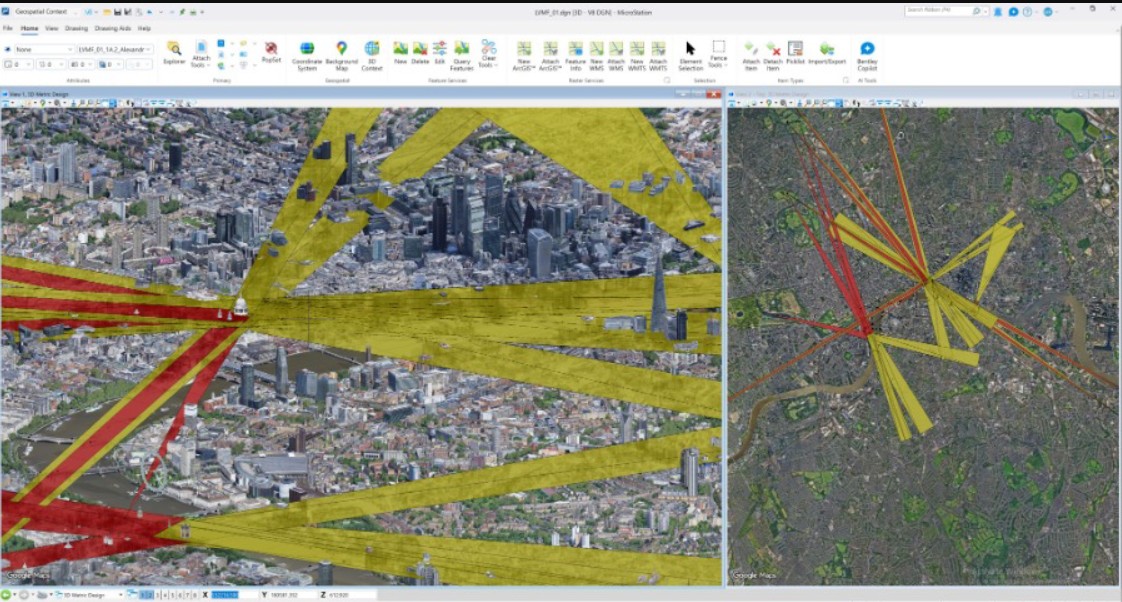
Matthew Felton explored London’s protected landmark views. Using Astra, a coding assistant, and MicroStation’s MCP server, he translated planning documents into three-dimensional volumes and sightlines. This allowed planning requirements to be examined within a design project, turning policy text into spatial information.
Ata Mesgarnejad then used a reference image to generate an offshore turbine in MicroStation and a corresponding structural model in SACS Precede. The experiment expanded into a wind farm without supplied dimensions or engineering specifications. Louis-Martin Losier animated the model and placed it off Scotland’s North Sea coast, illustrating how geographic context can support discussions about scale, site constraints, and community concerns.
Finally, Justin Dehorty used Astra and CesiumJS to visualize equations from OpenAI’s claimed Navier-Stokes breakthrough. The visualization explored a shrinking, accelerating fluid vortex associated with the mathematical result.
Together, these demonstrations suggest that AI could make engineering information easier to create, interpret, and communicate. They show exploratory workflows connecting AI instructions, engineering applications, and visual context to support infrastructure design decisions.
