

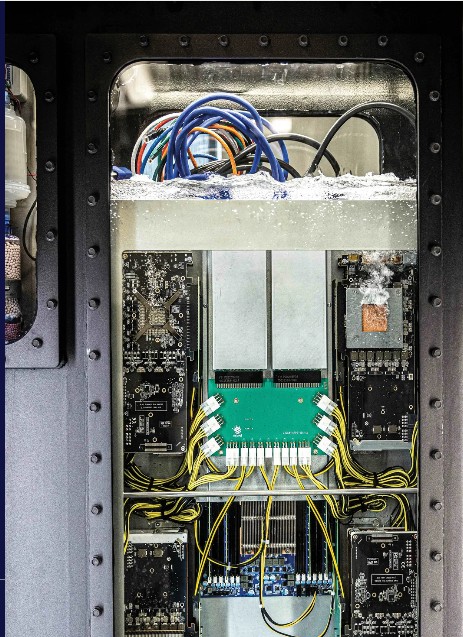
Traditional air cooling is failing to keep up with modern chip power densities, especially in AI datacenters. Modern GPUs already draw hundreds of watts, and emerging designs are headed toward kilowatt scales per chip. The result is rack and system heat loads that air can’t remove efficiently, tells this IEEE Spectrum article.
Liquid cooling offers much better thermal transfer. Water and dielectric fluids can absorb far more heat per volume than air and transfer it more efficiently, reducing fan loads and energy overhead. The article describes multiple approaches: cold plates (single-phase direct-to-chip), boiling coolant in cold plates (two-phase direct-to-chip), full immersion in nonconductive fluid (single-phase immersion), and even boiling immersion (two-phase immersion).
Single-phase direct-to-chip is the most mature method. It routes coolant through microchannels on cold plates attached to the hottest chips, removing heat at the source. Still, it’s limited by flow, pressure, and which components can be cooled this way. Two-phase direct-to-chip adds efficiency by letting the coolant boil (liquid → vapor) above hot surfaces, using latent heat to carry away more energy without temperature rise.
Immersion cooling bypasses cold plates altogether. In single-phase immersion, servers are submerged in a dielectric fluid that circulates to carry heat away uniformly. It lowers fan and dust issues but faces scaling limits at very high power densities. The most experimental is two-phase immersion, where the coolant boils directly on components in a vat. This approach offers exceptional cooling potential but brings challenges in fluid dynamics, material compatibility, vapor control, and servicing.
The article doesn’t pick a winner; the future likely lies in hybrid solutions combining these methods, depending on component types and density. It emphasizes that liquid cooling isn’t a niche option anymore; for AI workloads, it’s fast becoming necessary.
