

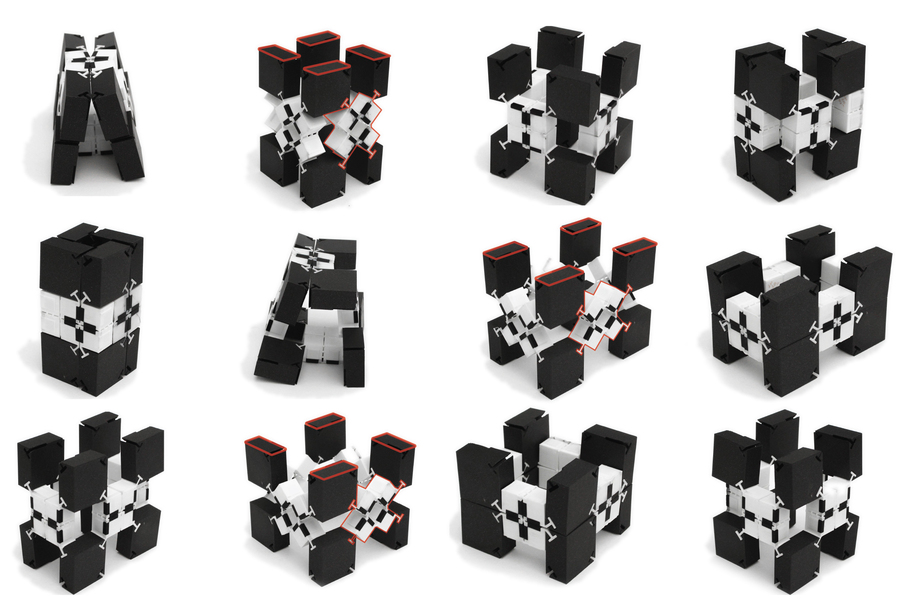
MIT researchers have developed modular, 3D-printed building blocks that can create shape-changing smart devices while maintaining electrical connections as they bend, rotate, stretch, or compress. Called bifur-circuits, the components could enable adaptable robotic grippers, assistive devices, reconfigurable antennas, and other interactive structures, tells MIT News.
Bifur-circuits are mechanical metamaterials, engineered structures whose repeating geometries determine their mechanical behavior. They build on auxetic metamaterials, which expand laterally when stretched. Earlier MIT research used auxetic structures to create antennas capable of switching among three configurations, but the limited number of shapes restricted their adaptability.
The new approach uses mechanical bifurcation, in which a structure suddenly changes behavior after an applied force crosses a threshold. By connecting and rotating bifur-circuit blocks around pivot points, designers can create multiple stable configurations. Adding more units increases the number of possible arrangements exponentially.
Conductive material integrated into each block maintains electrical connectivity regardless of the structure’s configuration. Connecting and rotating components also activates unique circuits between neighboring units. This enables a structure to determine its current geometry without relying on external wiring. Finding a conductive material flexible enough for repeated movement while maintaining efficient electrical performance was a major design challenge.
Durability tests showed that electrical connectivity remained intact after structures were compressed more than 10,000 times. The researchers also created a design and simulation tool that generates instructions for multimaterial 3D printers, allowing objects to be fabricated in one pass.
Demonstrations included a chair that recognizes when it transforms into a tea table and a controller that launches different video games depending on its shape. Potential applications include rehabilitation equipment, soft robotic grippers, adjustable communications antennas, and shelters that respond to changing conditions after disasters.
The researchers now plan to investigate additional metamaterial geometries and add greater interactivity, moving toward mechanically reconfigurable building blocks with intelligence embedded directly into their structure.
