

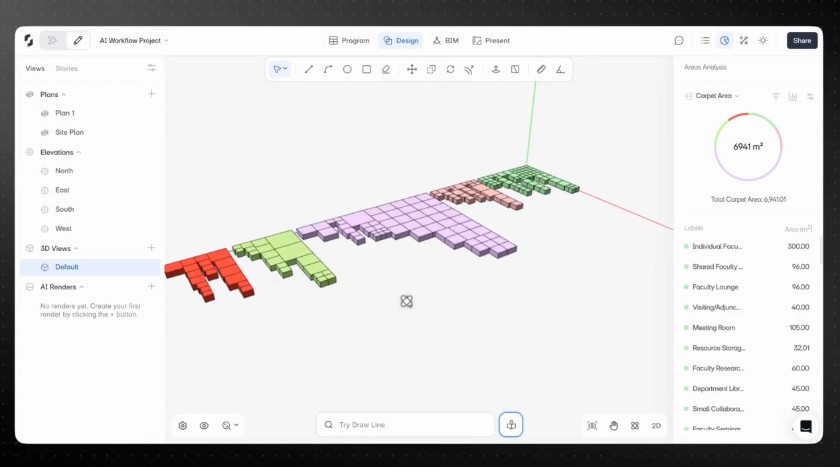
A building information model can respond to change in two ways. Parametric geometry follows shared rules, so changing a dimension updates connected elements. Nonparametric geometry remains independently editable and does not automatically follow every change. Snaptrude argues that the choice depends on design intent.
Shared rules make sense for repeated rooms, facade bays, structural grids, clearances, and other elements meant to change together. A useful rule has a clear reference, predictable scope, and tested effect on drawings, quantities, and schedules. Linking elements merely because they look alike can create hidden dependencies. A small adjustment may move unrelated geometry or cause conflicts difficult to diagnose. snaptrude.com
Independence is useful when one instance encounters a unique site condition, accessibility requirement, structural obstruction, or design variation. Imported geometry may also lack trustworthy references. Once an element is detached, changes to the original rule will no longer update it. Teams should document why it differs, identify who owns the exception, and set a review point when the broader design changes.
The article proposes a workflow: identify the governing rule, preview the effects of detachment, change only the instance, and check geometry, documentation, quantities, and exports. It recommends testing linked models with minimum and maximum values, combinations of parameters, irregular placements, and actions such as saving and reopening. Independent elements need the opposite check: a parent change should leave the exception intact while keeping it visible for coordination.
For AI-assisted design, Snaptrude separates pattern recognition from the decision to link elements and the deterministic execution of edits. An AI system may suggest that rooms share a rule, but a designer should approve its scope. Snaptrude describes its platform as combining freeform modeling with structured BIM, while advising teams to verify behavior on representative projects. The principle is to make relationships visible, intentional, and easy to test.
