

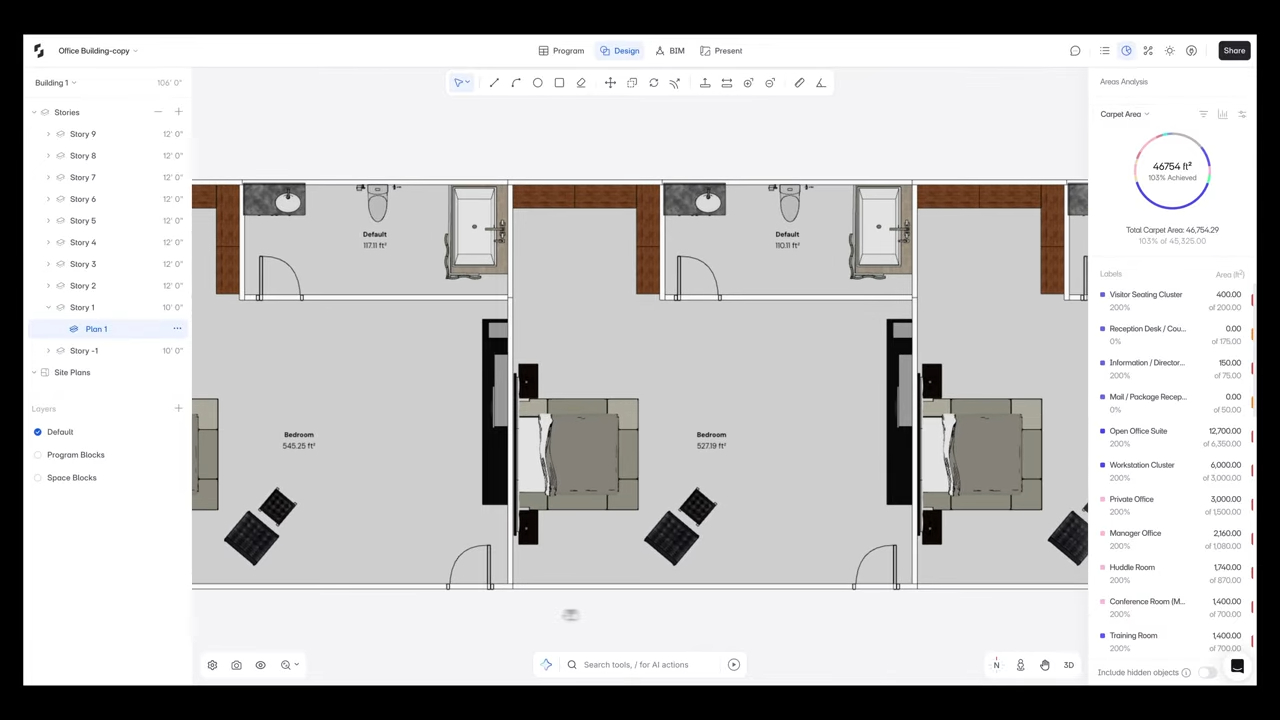
Reusable BIM room templates can accelerate planning, but reuse is reliable only when the content has been properly validated. Snaptrude recommends treating each room template as a governed package rather than a collection of objects. Validation should cover five areas: source authority, program data, room geometry, component relationships, and suitability for the specific project.
The process begins by establishing the template’s source, revision, mapping, and approval status. Snaptrude distinguishes between imported, translated, validated, project-adapted, and stage-approved content. These classifications matter because a translated template, for example, has not necessarily received design approval. Missing or uncertain information should remain visible rather than being replaced with assumed values.
Geometry requires equally careful testing. Teams should verify boundaries, dimensions, area, openings, door swings, equipment clearances, and accessibility. Templates should also be tested after resizing, rotating, and mirroring. Reviewing them in plan, section, and 3D can expose problems that a two-dimensional check might miss, including height, mounting, reach, and service conflicts.
Component relationships are another priority. Groups of furniture or equipment may encode workflow, access, clearance, or operational requirements. Validation should therefore preserve important relationships between objects, walls, entrances, and clearance zones rather than treating every component independently.
Snaptrude recommends running validation in a clean model before inserting reusable content into a live project. Reviewers should document exceptions, project adaptations, approval status, and changes from the original source. Templates should also be retired or quarantined when their sources become outdated or critical information cannot be verified.
Snaptrude’s Program Mode connects program information with AI-assisted space planning, area calculations, adjacency planning, and 3D design. Still, the article emphasizes that software does not replace professional review. A reusable room remains a starting point that must be tested against current workflows, regulations, equipment, services, and user requirements before project use.
