

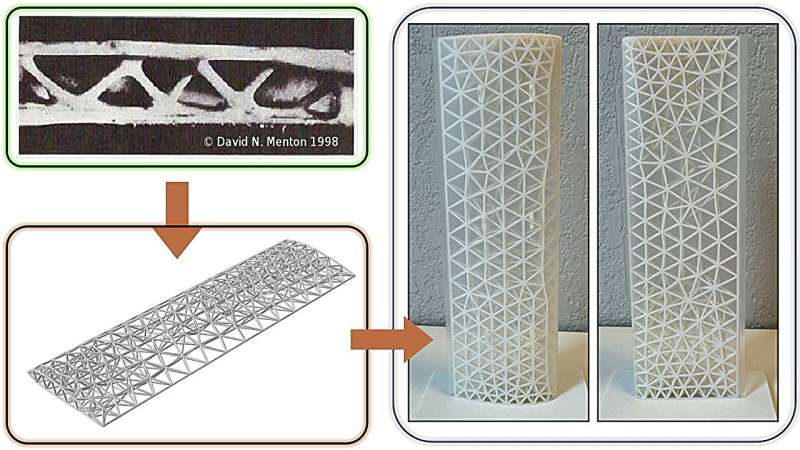
Aircraft designers have long struggled to reduce weight without sacrificing structural strength. A new study highlighted by Tech Xplore shows that bird bones may hold the answer. Researchers at the University of Illinois Urbana-Champaign have developed aircraft wing structures inspired by the hollow, irregular internal architecture of bird bones. Their findings demonstrate that nature’s designs can outperform conventional engineering approaches when paired with modern additive manufacturing.
Bird bones are remarkably light yet capable of withstanding the forces of flight. Instead of relying on the traditional arrangement of ribs, spars, and stiffeners inside an aircraft wing, the researchers created complex lattice structures that mimic the random internal patterns found in bird bones. These designs became possible through advances in 3D printing, which allow engineers to manufacture shapes that were previously too difficult or expensive to produce.
The team combined computer simulations with experimental testing to optimize the balance between weight and load-carrying capacity. Numerical models explored different design priorities, from minimizing mass to maximizing structural strength. The most promising configurations were then manufactured as prototype wings using additive manufacturing techniques.
To validate their approach, the researchers produced four wing samples. Two featured bird bone-inspired lattice structures, while the others used more conventional wall-based internal designs. Testing showed that the bioinspired wings delivered a 48–54% improvement in structural efficiency compared with traditional configurations. The results indicate that carefully arranged irregular lattices distribute loads more effectively while using less material.
The study also demonstrates the growing role of bioinspired engineering in aerospace design. Rather than copying nature’s appearance, researchers are applying the principles behind biological structures to solve engineering challenges. The authors emphasize that combining computational optimization with experimental validation is essential for creating practical designs.
Although further development is needed before such structures appear in commercial aircraft, the research highlights how advanced manufacturing is expanding design possibilities. By learning from bird anatomy, engineers may develop lighter, stronger aircraft that consume less fuel, reduce emissions, and improve overall performance without compromising structural integrity.
