

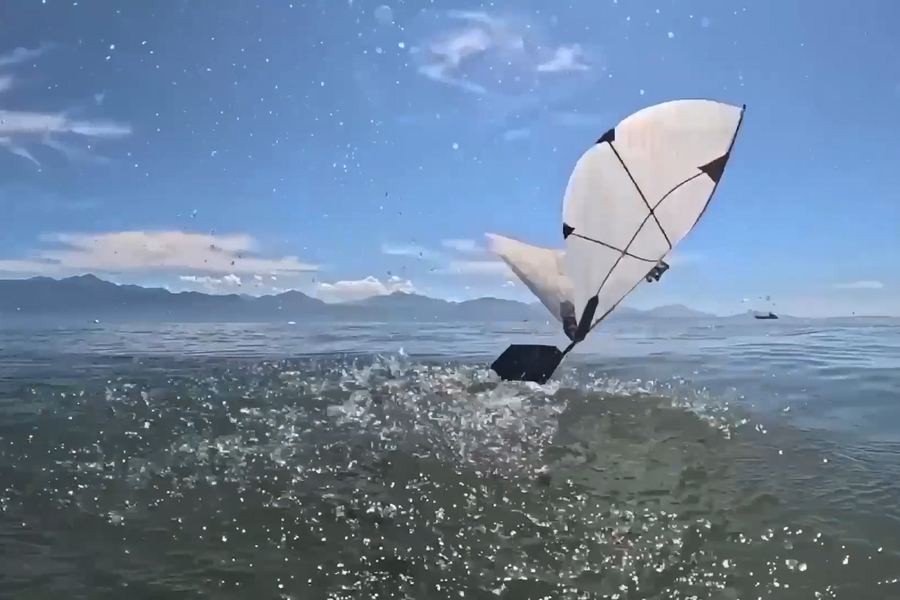
Engineers at MIT have developed a bird-inspired robot capable of both flying through the air and swimming underwater, demonstrating a new approach to multimodal robotics. Inspired by diving seabirds such as puffins and murres, the lightweight robot uses the same flapping wings to propel itself in both environments. The design eliminates the need for separate propulsion systems, reducing weight and mechanical complexity while expanding the robot’s range of movement. The research could lead to versatile robots for environmental monitoring, search and rescue, and infrastructure inspection, tells MIT News.
Unlike conventional drones that rely on propellers optimized only for flight, the new robot is designed to operate efficiently in air and water despite the dramatic difference in fluid density. Its wings generate lift during flight and produce thrust underwater through controlled flapping motions. By carefully adjusting wing movement and body orientation, the robot can maintain stability and maneuver effectively in both environments without changing its propulsion mechanism.
The research team focused on reproducing the efficient locomotion of diving birds, which routinely transition from flying to swimming while hunting for food. Through computational modeling and experimental testing, the engineers optimized wing geometry, flapping frequency, and control algorithms to balance the conflicting aerodynamic and hydrodynamic requirements. The result is a compact robotic platform capable of performing two very different modes of locomotion using a single integrated design.
The robot’s dual capabilities could prove valuable in situations where conventional aerial or underwater vehicles are limited. It could fly rapidly to remote coastal areas before entering the water to inspect marine ecosystems, underwater structures, or disaster zones. Similar systems may also support scientific exploration, wildlife observation, and military reconnaissance by moving seamlessly between environments without requiring human intervention or multiple vehicles.
Although the current prototype remains an experimental platform, the work demonstrates the growing influence of bioinspired engineering in robotics. Future research will focus on improving endurance, autonomous navigation, and transitions between air and water. As materials, control systems, and battery technologies continue to advance, robots modeled after diving birds could provide new capabilities for missions that demand mobility across multiple environments. The study also highlights how observing natural systems can inspire engineering solutions that simplify mechanical design while expanding functional performance.
