

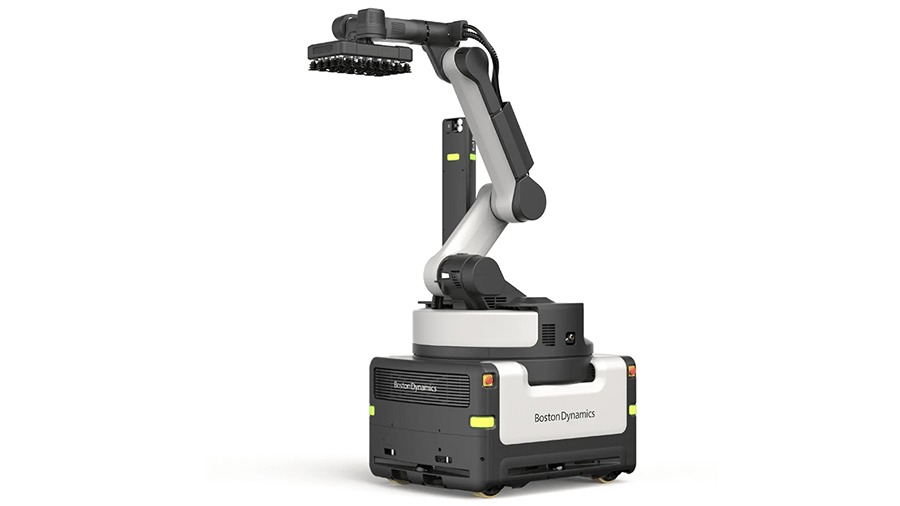
BOSTON, MA, Nov 10, 2026 – Boston Dynamics has unveiled Stretch Gen 2, a mobile robot for trailer unloading that introduces hardware changes to simplify maintenance. The redesign reduces internal cabling by 81% and uses modular components that can be replaced in less time. A full swerve drive replacement can take about one hour, compared with a full day previously.
The redesign follows an analysis of more than 100,000 operating hours and tens of millions of boxes unloaded by first-generation stretch robots. Boston Dynamics used the data to identify causes of unplanned downtime and made changes to the robot’s mechanical and electrical systems.
“Our customers count on Stretch to keep freight moving, and every hour a robot sits idle is an hour of work that piles up on the dock,” said Brian Donnelly, vice president & general manager of Logistics Robotics at Boston Dynamics. “With Gen 2, we focused on the things that actually took robots offline in the real world. We made it tougher, we made it simpler to service, and we made sure it keeps getting better long after it’s deployed.”
Stretch Gen 2 uses automotive-grade connectors to withstand vibration from high-torque box handling and uneven floors. Its upgraded gripper combines new valve systems with precise sensing for box grasping and placement. Continuous rotation joints move beyond 360° without mechanical hard stops, reducing joint stress.
Removing approximately half a mile of internal cabling addresses a major source of intermittent electrical faults and wiring wear. Boston Dynamics also lowered and recessed the emergency stop and introduced new exterior panel materials to reduce accidental stoppages and damage from falling boxes.
The modular design supports faster component replacement. Removing cables and wiring harnesses simplifies servicing, while high-strength fasteners reduce tool changes and repair time. New onboard diagnostics and maintenance tools allow maintenance teams to handle routine servicing with less support.
Computing and Unloading Performance
Stretch Gen 2 incorporates a redesigned onboard computing platform that supports software updates across deployed fleets. Regular releases improve case detection, motion planning, picking strategies and world modeling without requiring hardware changes.
According to Boston Dynamics, the robot can unload up to 1,000 cases per hour, although throughput depends on case weight, and how neatly or irregularly boxes are stacked. The battery supports two shifts of operation, while a fast charger brings it to 90% charge in approx. 75 minutes. Onboard lighting allows Stretch Gen 2 to operate inside dark trailers. Its pre-trained vision system detects most packages from initial use without programming.
Source: Boston Dynamics
About Boston Dynamics

Boston Dynamics, headquartered in Waltham, MA, develops mobile robots used in inspection, logistics and infrastructure work. Founded in 1992, the company offers products that include Spot, a four-legged robot for industrial inspection, and Stretch, a robot designed for warehouse case handling. Its customers span logistics operations, construction sites, industrial facilities and research organizations. The company serves hundreds of customers in more than 35 countries and employs about 800 people. Its systems focus on mobile operation, data collection and integration with existing workflows rather than fixed, repetitive automation.
