

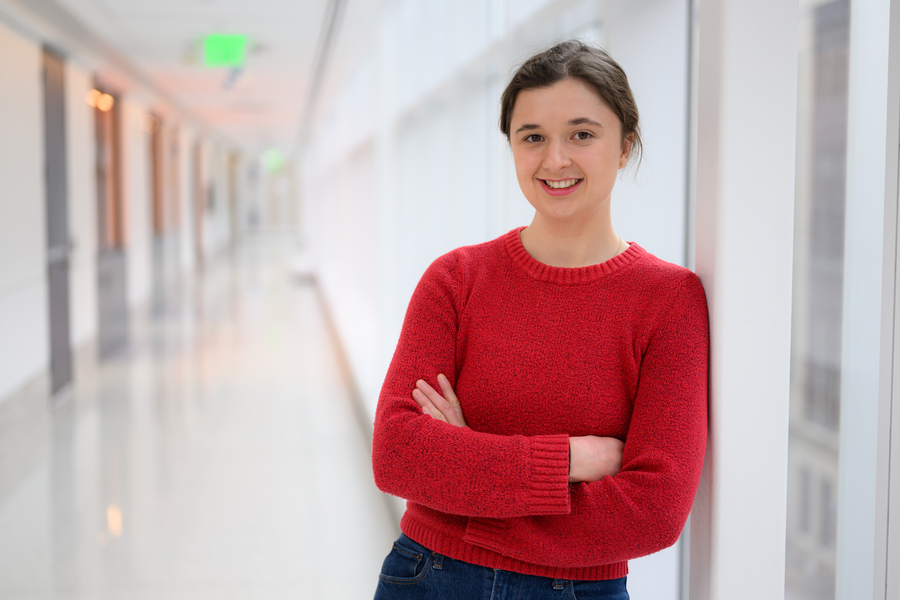
Miranda Schwacke, a doctoral student at the Massachusetts Institute of Technology (MIT) Department of Materials Science and Engineering, researches neuromorphic computing, a type of hardware that mimics the brain’s architecture by integrating storage and processing in the same device. Modern AI systems often use large amounts of energy because they shuttle data between separate memory and compute units, whereas the brain performs both tasks together more efficiently, says MIT News.
Schwacke works in Professor Bilge Yildiz’s lab exploring ionic synapses: thin-film devices, such as tungsten oxide channels, whose conductivity can be tuned via insertion of magnesium ions, a design intended to mirror synaptic behavior in the brain. She chose magnesium over hydrogen because hydrogen tends to escape and destabilize devices; magnesium offers a route to more stable, semiconductor-compatible neuromorphic elements.
Her interest traces back to a childhood fascination with science and robotics. As an undergraduate at California Institute of Technology (Caltech), she worked on dye-sensitized solar cells and developed a materials-science mindset: how structure at the atomic level translates into everyday performance. Beyond the lab, she is active in outreach, organizing science-fair activities, mentoring young women in STEM, and translating research for broad audiences.
Her lab emphasizes fundamental understanding rather than jargon-heavy work. Yildiz notes that the brain’s efficiency stems not only from its architecture but also from avoiding constant data transfers between separate modules, a principle her team seeks to replicate. Schwacke sees communication skills as core to research impact and intends to carry them into a future academic career where she hopes to inspire the next generation of engineers and scientists.
Her work addresses a pressing challenge: AI’s unrelenting growth in compute and energy consumption demands new device paradigms. By combining electrochemistry, materials science, and brain-inspired design, her research points toward hardware platforms that could dramatically lower the energy footprint of large-scale machine learning.
