

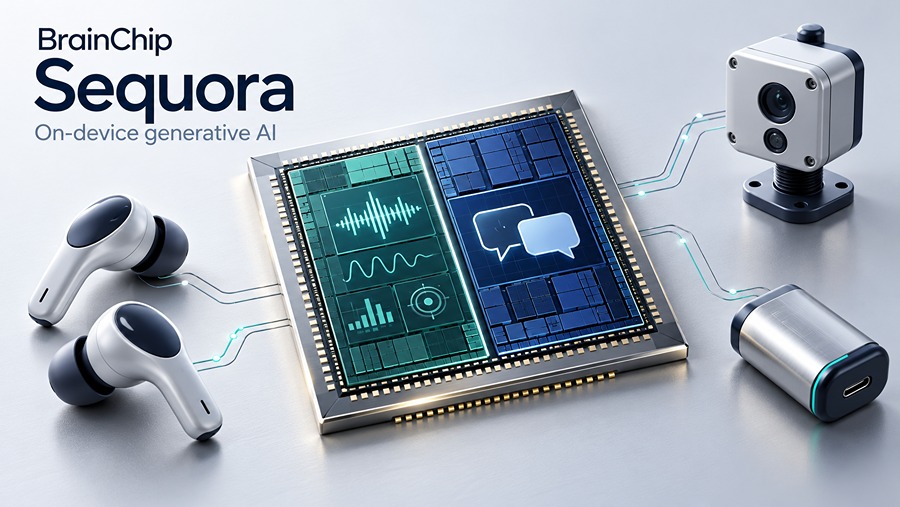
LAGUNA HILLS, CA, Oct 15, 2026 – BrainChip Holdings has introduced Sequora Core IP, a licensable processor design to run generative AI, including large language models (LLMs), on battery-powered devices. Pairing Sequora with Akida technology combines generative processing and sensor data analysis on the same device.
According to BrainChip, Sequora’s design keeps memory use fixed regardless of data-stream or conversation length. The design supports models ranging from a few million to parameters up to 3 billion.
“Our commercial and aerospace/defense customers are designing AI into many of the next-generation edge systems that provide real-time processing and decision-making in congested and contested environments with minimal footprint in size, weight and power,” said Frank Ferrante, chief executive officer at ForwardEdge ASIC. “Sequora puts generative AI in a low-power IP core that fits many of the demands of the custom silicon we build. It gives us a path to add on-device intelligence to mission-critical edge ASICs.”
Sensor Processing and Generative AI
The two processor designs handle different workloads. Akida processes streaming sensor data, including vibration, audio, radar, raw radio-frequency IQ data and biological signals. Sequora runs generative and sequential AI workloads, including on-device LLMs, voice-to-voice interaction and AI agents.
BrainChip identifies applications in consumer voice devices, earbuds, wearables, sensor nodes, aerospace and defense, automotive and industrial radar, industrial IoT, and medical and biomedical devices.
“The edge is where AI becomes useful in everyday infrastructure, from utility meters to mobility systems,” said Jay Kim, CEO of edgeAI Inc. “BrainChip saw early that efficiency would decide who wins at the edge. Now they’re applying that same thinking to generative AI, bringing language and reasoning capabilities to devices that run on a small battery.”
Sequora is designed to address memory bandwidth constraints, memory traffic that limits model size on battery power, response latency and privacy. Sequora runs generative and sequential AI without sending data off the device, keeping all local.
“Customers are not asking for just a signal classifier or a language model,” said Sean Hehir, chief executive officer, BrainChip. “They want both, in the same product, on the same battery. Akida and Sequora together deliver exactly that.”
Licensing and Implementation
Sequora is available now as licensable semiconductor intellectual property. Customers integrate the design into their own SoC and manufacture it at their foundry and process node.
BrainChip delivers Sequora as process-portable, fully synthesizable register-transfer level code. The package includes tools for testing the processor design, preparing it for chip manufacturing and developing AI applications.
Source: BrainChip Holdings
About BrainChip Holdings

BrainChip develops processors, software and tools for AI in connected devices. Its Akida portfolio includes processor chips, licensable intellectual property, neural-network models, software kits, training tools, simulators and reference platforms. The company serves chip designers, device manufacturers and developers working on embedded systems. Its application areas include automotive, industrial equipment, defense, aerospace, consumer electronics and internet-connected devices. Uses include audio processing, voice commands, object detection and sensor monitoring. BrainChip Holdings was incorporated in Australia in 2004. The company lists its headquarters in Laguna Hills, CA.
