

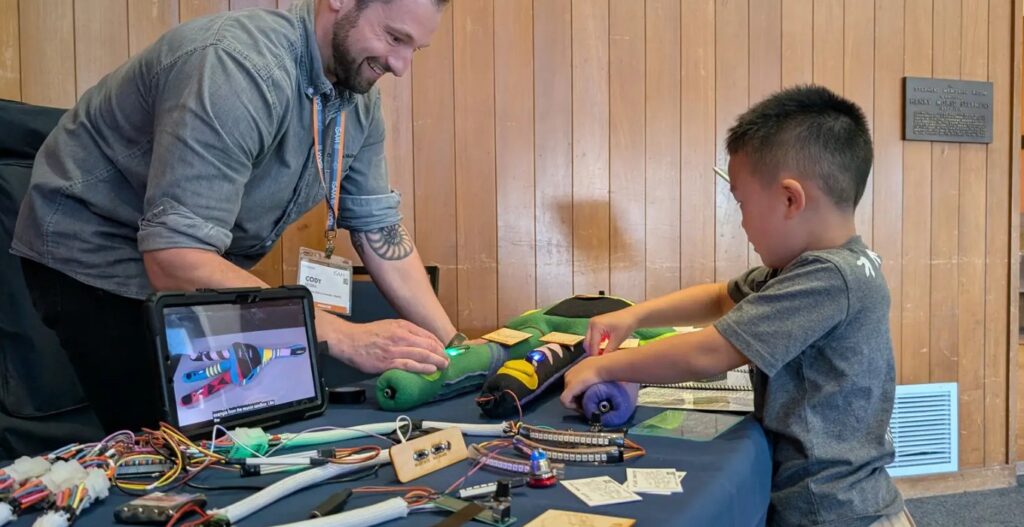
Researchers and educators at Carnegie Mellon University’s IDeATe network created a soft, squishy, brightly-colored physical device designed to demystify the foundational building blocks of machine learning for middle school students.
The device, called the “Plush Neuron,” incorporates a neural-network model represented physically: three “dendrite” inputs (with buttons and adjustable weights), a “soma” that sums inputs and compares with a threshold, and an “axon” that triggers lights and sounds when firing. Buttons allow students to change input weights and set thresholds, enabling them to pose simple decision problems and see how a neuron would “fire” or stay silent in response, offering a concrete window into how AI models make choices and how weighting and bias affect outcomes.
The team emphasized that even learners who haven’t yet studied algebra can grasp these ideas through tactile play and visual feedback: “Everyone, even middle schoolers, needs to know a little about these building blocks of artificial intelligence… but these young learners haven’t even studied algebra yet.”
The device was developed collaboratively across disciplines, such as electrical hardware, software, textiles, and design, through IDeATe, leveraging a prototype by technical specialist Cody Soska, programming by Professor Dave Touretzky, and textile/fabrication work by instructors specializing in soft technologies.
Already, the Plush Neuron has been used in teacher-training workshops and presented at educational symposia, including EAAI-25, with early field deployment via partners including schools in Georgia and the AI4MiddleSchools initiative.
By turning an abstract concept into a tactile, interactive object, the CMU team offers a new way for young learners to engage with AI concepts, making them approachable, tangible, and embedded in playful exploration rather than purely digital lessons.
