

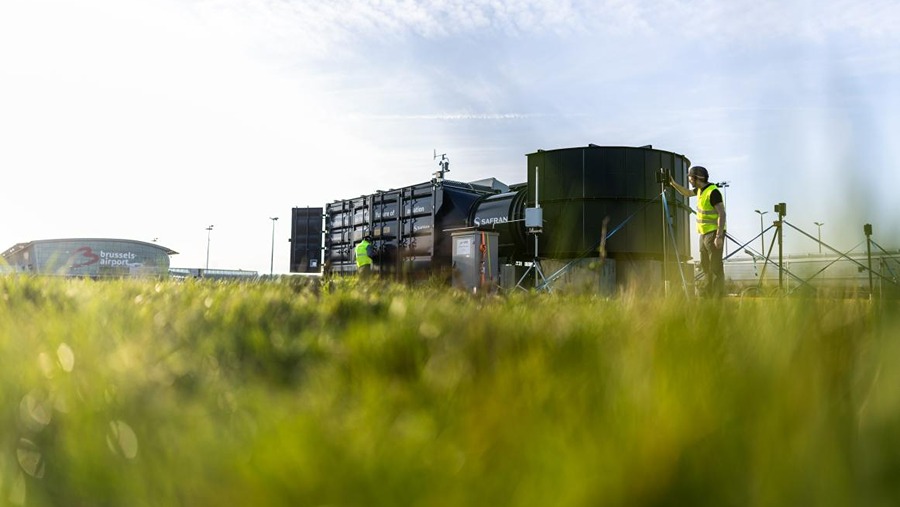
A containerized mobile air-filtration prototype designed to capture fine and ultrafine particles near tarmac operations is scheduled to begin a second test at Brussels Airport on June 22, in a project with Safran Aero Boosters.
Developed by Safran Aero Boosters with support from the Walloon Region, the prototype is installed in a container about 12 meters long in an area next to the tarmac. The system uses industrial filtration to remove fine and ultrafine particles from surrounding air. Brussels Airport is the first airport in the world to test this type of air filter.
The second test phase will run until the end of Sep’2026. During that period, Brussels Airport and Safran Aero Boosters will measure the filter’s impact and assess whether the technology could be deployed at different locations to improve air quality.
“As an airport, we are happy to contribute to innovative solutions with a positive impact on the local living environment. The pilot project with the mobile air filter is a great example of how, thanks to innovation, we can improve local air quality. According to the initial results, it is a promising technology that can make a difference for our staff and local residents,” says Arnaud Feist, CEO of Brussels Airport.
“Air quality management is at the heart of Safran Aero Boosters’ concerns, thanks to the expertise we have developed through our engine test benches, where we learned how to control airflows, particle treatment, and the monitoring of fine particulate matter. This prototype at Brussels Airport illustrates our ability to adapt our industrial and innovative technologies beyond their usual environments to address real operational challenges. I would like to thank Brussels Airport for an exemplary, swift, and efficient collaboration, as well as the Walloon Region for its decisive support for innovation,” says François Lepot, CEO of Safran Aero Boosters.
The device operates between 8 a.m. and 8 p.m. Air enters through a fan at the front of the unit, passes through the filtration system, and is discharged at the rear after fine and ultrafine particles are captured. The purifies air then mixes back into the surrounding air.
Initial Air Measurements Show Positive Results
The first test phase took place from December 2025 to March 2026 on the tarmac in front of Pier A. Safran Aero Boosters worked on that phase with KMA Filter, the University of Liège, the von Karman Institute, and GD Tech.
To assess the filter’s performance during the first test period, the Scientific Institute of Public Service and the Flemish Institute for Technological Research carried out air-quality measurements. The initial results were positive, according to the project partners. After the second test phase, the partners will analyze whether the technology can be deployed at airports and other locations where air-quality improvements are needed.
This project has received funding from the Walloon Region and from the European Union’s Horizon 2020 research and innovation program.
Source: Safran Group
About Safran Aero Boosters

Safran Aero Boosters designs and manufactures modules, equipment and test systems for aircraft and space engines. The Liège, Belgium-based company produces low-pressure compressors, front bearing supports, fan disks, oil systems, cooling equipment and space propulsion components. It also supplies engine test facilities, control systems, data acquisition equipment and related services. Safran Aero Boosters serves aircraft engine manufacturers, space programs, commercial aviation, military aviation and aerospace testing organizations. The company traces its origins to FN’s Engine Division, established in Belgium in 1949. It operates as part of Safran Group and maintains activities in Belgium and the United States. Its products are used in turbofan engines and European space launch systems. Safran Aero Boosters reports about 2,000 employees worldwide.
