

In this opinion article, Oleg Shilovitsky argues that the rapidly evolving AI landscape is teaching product lifecycle management (PLM) developers a lesson that the software industry has encountered before. The catalyst for the discussion is the sudden suspension of Anthropic’s fictional frontier AI models, Fable 5 and Mythos 5, following a U.S. government export-control directive. The event serves as a reminder that AI capabilities can disappear overnight because of factors outside a developer’s control.
Shilovitsky draws parallels with earlier eras of engineering software. During the CAD boom, some vendors tightly controlled their platforms and ecosystems, effectively acting as gatekeepers. Companies that fostered openness and developer communities generally thrived, while those that restricted access often struggled to maintain influence. Later, during the database wars, successful enterprise applications were designed to operate above the database layer, allowing customers to choose among platforms such as Oracle, SQL Server, or DB2 without disrupting business workflows.
According to the author, AI introduces a new complication. Unlike CAD or database platforms, AI vendors are not always the final authority over their products. Regulatory agencies can intervene, creating disruptions that neither developers nor AI providers anticipated. As a result, software companies that build critical functionality around a single AI model expose themselves to significant operational risk.
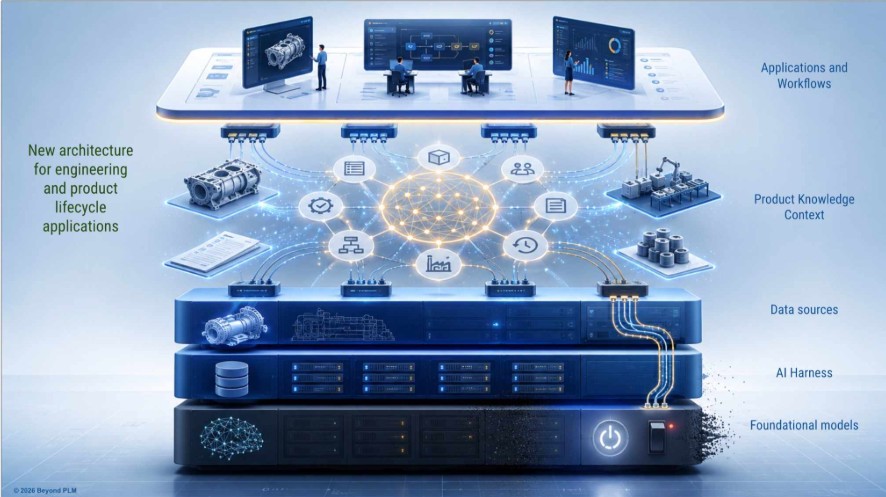
The article’s central recommendation is that PLM and engineering software developers should treat AI models as interchangeable components rather than the foundation of their products. The true value of a PLM system lies in its proprietary data, workflow orchestration, domain expertise, and integration framework. These assets remain under a company’s control even when a model becomes unavailable.
Shilovitsky concludes that model independence should become a core architectural principle for AI-enabled PLM systems. Just as portability once protected software from dependence on specific CAD or database vendors, the ability to switch among AI models may become essential for maintaining resilience, continuity, and long-term competitiveness in engineering software.
