

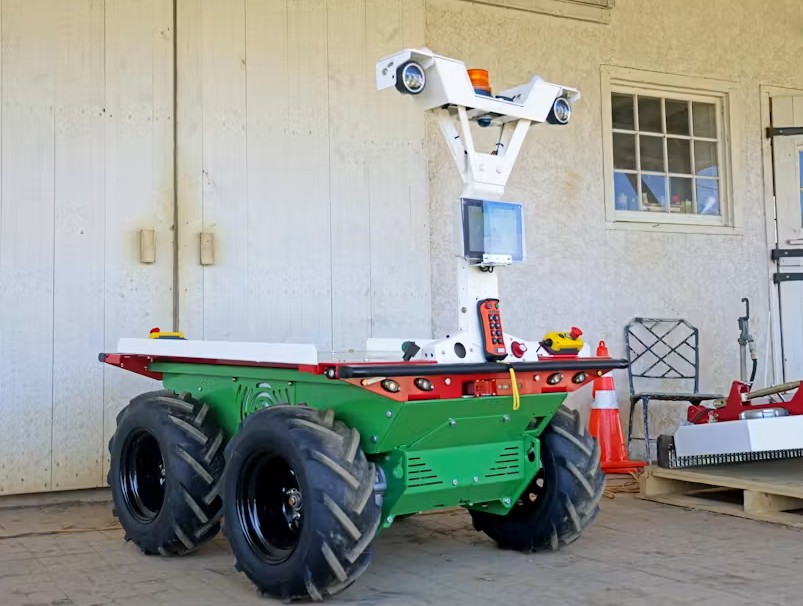
After eight years deploying autonomous robots, Burro has learned that simulation cannot anticipate every condition a machine meets. In this Machine Design article, Burro’s vice president of engineering, Vibhor Sood, describes incidents that changed the company’s perception software, sensors, and validation. His argument is that deployment data should feed the next design cycle, not merely confirm a finished robot.
Reflective black plastic around pallets confused cameras and produced inconsistent LiDAR returns, making an obstacle difficult to detect. At another site, standing water on a greenhouse roof caused GPS interference after weeks of operation. Burro responded to the first problem with better perception and training data. The second required a redesigned GPS antenna configuration and specialized filtering. These examples show why an AI model update is sometimes appropriate, while other failures demand hardware changes.
Vineyards and greenhouses bring variation. Robots must distinguish flexible vines they can pass through from rigid obstacles they must avoid. Vegetation can wrap around wheels or strike a bumper, triggering a safety stop. Growing plants may obscure landmarks, while floors, trailers, and layouts differ between sites. A robot proven in one environment must be tested against others that change.
Fleet data helps Burro decide whether a rare event is an anomaly or an emerging requirement. GPS trouble near power lines became more consequential as deployments expanded. Sood points to miles per fault as a measure of operational reliability and treats operator interventions as evidence of where autonomy falls short.
Capable AI and foundation models may reduce familiar errors, but they leave engineers confronting less predictable combinations of perception, mechanics, and human behavior. Sood argues for a continuous loop: simulate scenarios, test controlled performance, deploy robots, investigate failures, and bring those findings back into training, hardware design, and simulation. Reliability grows when engineers learn from conditions they did not know to model.
