

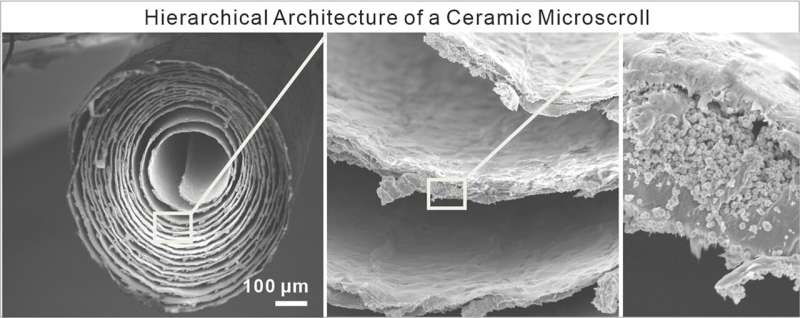
Researchers at the University of Stuttgart and the Max Planck Institute for Solid State Research have developed tiny ceramic scrolls that rapidly unroll and recoil under magnetic control. Inspired by the rolling motion of a butterfly’s proboscis, the technology could provide compact actuators for micro- and soft robots that need to grasp, move, and manipulate small objects, tells Tech Xplore.
The researchers created the microscrolls from ultrathin vanadium pentoxide films embedded with magnetic iron oxide nanoparticles. A simple mechanical process transforms the flat films into three-dimensional structures. The film is gently peeled from its substrate using a razor blade, which bends the material continuously until it forms a tightly wound scroll. When a magnet approaches, the scroll rapidly unrolls. Removing the magnetic field allows it to return automatically to its original coiled shape.
Unlike conventional ceramics, which are generally brittle, the ultrathin films remain flexible because of their hierarchical nano- and microstructure. This architecture allows the ceramic to undergo elastic deformation without losing its structural integrity. A complete actuation cycle takes about 150 milliseconds.
The microscrolls are only a few micrometers wide and measure a few hundred micrometers in diameter when coiled. Yet they can extend up to 25 millimeters and lift more than 30 times their own weight. Tests also showed strong durability, with the actuators continuing to function after 5,000 cycles.
Researchers can arrange multiple microscrolls into programmable arrays, allowing coordinated lifting, transportation, and manipulation of microscopic objects. More importantly, the manufacturing approach is not limited to vanadium pentoxide. It could be applied to other organic and inorganic thin films, creating programmable microsystems for robotics, sensors, electronic components, and energy-storage devices. The research demonstrates how bio-inspired materials and simple manufacturing techniques could provide practical building blocks for future miniature machines.
