

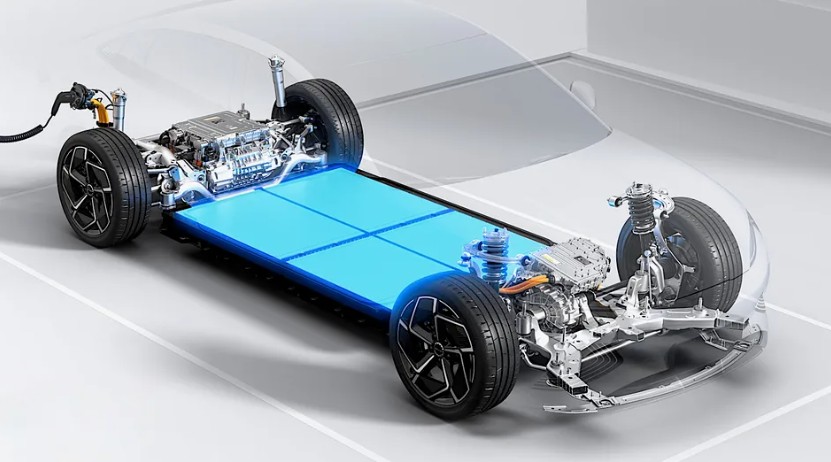
BYD has unveiled its second-generation Blade Battery pack, introducing a significant redesign that goes beyond cell chemistry to address battery integration, thermal management, and vehicle manufacturing. According to Design News, the new battery system incorporates several engineering innovations intended to improve energy efficiency, packaging density, safety, and production economics for electric vehicles.
A major feature of the new design is the integration of key battery control functions directly into the pack. Rather than relying on numerous separate electronic modules and wiring assemblies, BYD has consolidated control systems within the battery architecture itself. This approach reduces component count, simplifies assembly, and lowers weight while improving reliability and manufacturability.
The battery also introduces a refrigerant-based cooling system. Traditional EV battery packs often use liquid cooling plates that circulate coolant through dedicated channels. BYD’s design instead allows refrigerant from the vehicle’s thermal management system to participate directly in battery cooling. This arrangement improves heat-transfer efficiency, helping to maintain more uniform cell temperatures during charging, discharging, and high-performance operation. Better thermal control can enhance battery longevity, charging speed, and overall vehicle efficiency.
The article highlights that the redesigned pack builds on the strengths of BYD’s original Blade Battery concept, which gained attention for its use of lithium iron phosphate (LFP) chemistry and its strong resistance to thermal runaway. The second-generation architecture further improves space utilization by reducing structural complexity and integrating multiple functions into fewer components. This contributes to higher volumetric efficiency and allows automakers to extract more usable energy from a given battery footprint.
Another notable aspect is BYD’s emphasis on cell-to-body integration, reflecting a broader industry trend toward making battery packs structural elements of the vehicle. By combining battery, electronics, cooling, and structural functions, manufacturers can reduce weight and increase vehicle rigidity.
The new Blade Battery demonstrates how innovation in EVs is increasingly focused on system-level engineering rather than chemistry alone. Through tighter integration of controls, thermal management, and vehicle structure, BYD aims to deliver batteries that are safer, more efficient, and easier to manufacture at scale, strengthening its position in the rapidly evolving electric vehicle market.
