

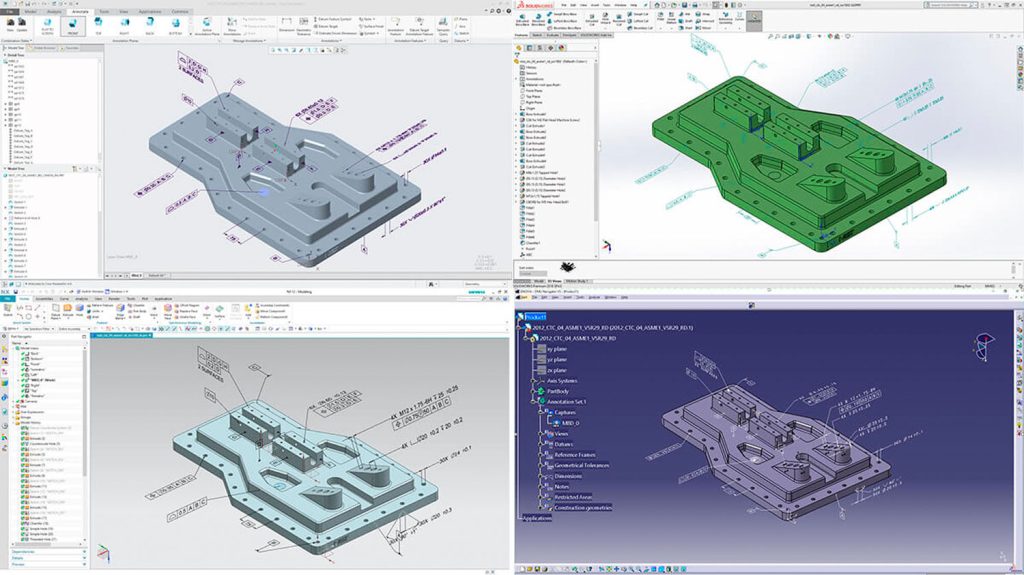
CAD translators remain essential for engineering teams that exchange design data across incompatible software platforms. Develop 3D’s guide examines tools that convert native and neutral CAD formats while preserving critical geometry, metadata, product manufacturing information, and design intent.
Translation requirements vary considerably. Basic tools can convert models among formats such as STEP, IGES, Parasolid, ACIS, STL, JT, and IFC. More advanced systems handle batch processing, geometry repair, validation, model-based definition data, and feature histories. They can also allow suppliers and manufacturing partners to access engineering information without purchasing multiple native CAD applications.
CAD Exchanger Lab offers relatively affordable translation across more than 30 formats while retaining B-Reps, meshes, metadata, and PMI. Datakit CrossManager emphasizes ease of use and modular pricing, while TransMagic Pro adds automated geometry repair and model validation.
At the enterprise level, capabilities become more sophisticated. Capvidia MBDVidia focuses on preserving and validating semantic PMI for model-based workflows. Core Technologie’s 3D_Evolution supports large-scale automated conversion, data healing, quality checking, and geometry simplification. Elysium CADfeature and ITI Proficiency go further by translating feature trees instead of reducing models to static geometry, making them valuable for major CAD migration projects.
Engineers can also use interoperability tools built into major CAD platforms. Autodesk Inventor AnyCAD, Solidworks 3D Interconnect, PTC Creo Unite Technology, and Siemens NX technologies allow users to reference or work with models created in competing systems. However, imported geometry may lack its original modeling history, limiting downstream editing.
The guide shows that choosing a CAD translator depends on more than supported file formats. Engineers must consider data fidelity, geometry repair, PMI preservation, automation, PLM integration, and cost.
For occasional file conversion, inexpensive tools may be sufficient. Complex manufacturing and model-based workflows, however, can justify specialized translation systems that preserve engineering intelligence throughout the product development process.
