

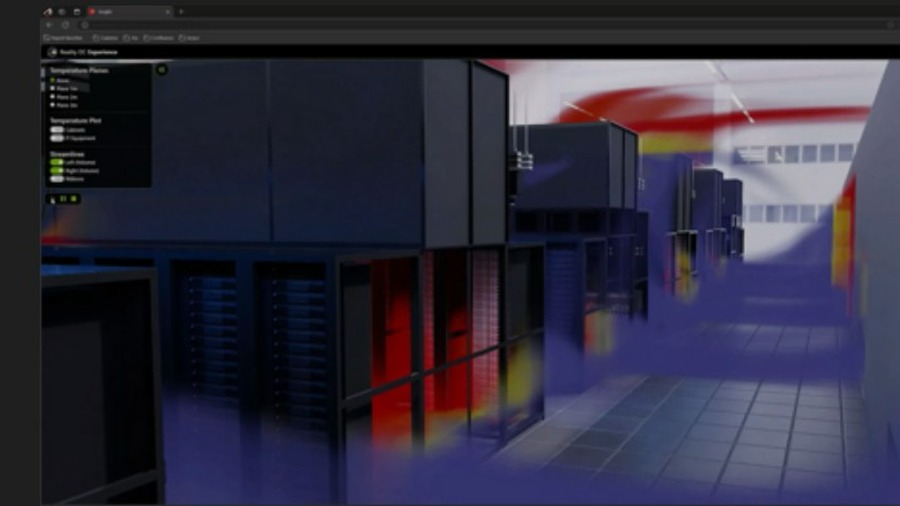
SAN JOSE, CA, Sep 12, 2025 – Cadence has announced the expansion of Cadence reality digital twin platform library with a digital twin of NVIDIA DGX SuperPOD with DGX GB200 systems. The update gives designers and operators a way to model AI factories virtually before construction begins. It allows them to test service-level targets while accounting for real-world constraints such as cost, space, energy, cooling, and environmental impact.
“Rapidly scaling AI requires confidence that you can meet your design requirements with the target equipment and utilities,” said Michael Jackson, senior vice president, system design and analysis, Cadence. “With the addition of a digital model of NVIDIA’s DGX SuperPOD with DGX GB200 systems to our Cadence Reality Digital Twin Platform library, designers can model behaviorally accurate simulations of some of the most powerful accelerated systems in the world, reducing design time and improving decision-making accuracy for mission-critical projects.”
“Creating the digital twin of our DGX SuperPOD with DGX GB200 systems is an important step in enabling the ecosystem to accelerate AI factory buildouts,” said Tim Costa, general manager, industrial and computational engineering, NVIDIA. “This step in our ongoing collaboration with Cadence fills a crucial need as the pace of the innovation increases and time-to-service shrinks.”
The Cadence reality digital twin platform allows engineers to create digital models of data centers using vendor-supplied components that behave like physical equipment. Designers can place these models into a virtual layout to plan power, space, cooling, and performance before construction begins. The platform also lets users simulate failure scenarios and evaluate upgrade options in the same environment. After deployment, it can be used to track system performance and adjust infrastructure as data center requirements change over time.
The addition of the NVIDIA DGX SuperPOD with DGX GB200 systems to the library is part of a collaboration between Cadence and NVIDIA. Earlier this year, the two companies announced the Cadence reality digital twin platform’s support of the NVIDIA Omniverse blueprint for AI factory design and operations. Cadence and NVIDIA continue to improve the data center and AI factory build process by expanding the capabilities of the Cadence reality data center digital ecosystem, ensuring it stays relevant to the latest designs.
The Cadence reality digital twin platform’s library comprises over 14,000 items from more than 750 vendors. All data center parts should be represented with a corresponding library item. If a part is not included, Cadence will create and add it as part of its software support.
AI Infra Summit Participation
Cadence will be participating at the AI Infra Summit at the Santa Clara convention center on Sept. 9 – 11. The Cadence reality digital twin platform library will be on display in #booth409 and the company will also take part in the following panel, keynote and talk:
- Cadence fellow, Badarinath Kommandur, will moderate the panel titled “Chip Design: Designing Power Efficient Chips – from the Edge to the Data Center” on Sep 9 at 2:35 p.m. PDT.
- Cadence AI fellow, Charles Alpert, will keynote on Sep 10 at 10:55 a.m. PDT on “Design for AI and AI for Design.”
- Cadence group director, Sherman Ikemoto, will give a talk on September 10 at 2:20 p.m. PDT titled, “AI Data Center Operations: Simulation-Driven Data Center Design, Operations and Risk Management.”
Source: Cadence
About Cadence

Cadence Design Systems, Inc. is a U.S.-based technology firm that develops electronic design automation (EDA) tools, hardware, and IP for designing integrated circuits and electronic systems. Formed in 1988 through the merger of SDA Systems and ECAD, the company is headquartered in San Jose, CA. Cadence provides software and solutions for designing SoCs, PCBs, and complete electronic systems used in the semiconductor, automotive, aerospace and defense, telecommunications, and consumer electronics industries. Its tools support both digital and analog design workflows. As of 2024, Cadence reported annual revenue of approximately $4.64 billion and employed about 12,703 people globally. The company’s technology supports the design, verification, and optimization of complex electronics across various industries.
About NVIDIA

NVIDIA Corporation, founded in 1993 and based in Santa Clara, CA, designs and produces graphics processing units, systems on chips, networking hardware and AI software such as CUDA. Its hardware and software support applications in gaming, data centers, autonomous vehicles, professional visualization, robotics, health care and energy. The company pioneered the GPU in 1999 and later expanded into accelerated computing and AI infrastructure. In gaming, its GPUs drive high-performance rendering, while in AI and high-performance computing, its systems provide the infrastructure for training and deploying large-scale models. Nvidia also develops tools for robotics and autonomous driving systems. For the fiscal quarter ending July 2025, it reported revenue of $46.7B and net income of $26.4B.
