

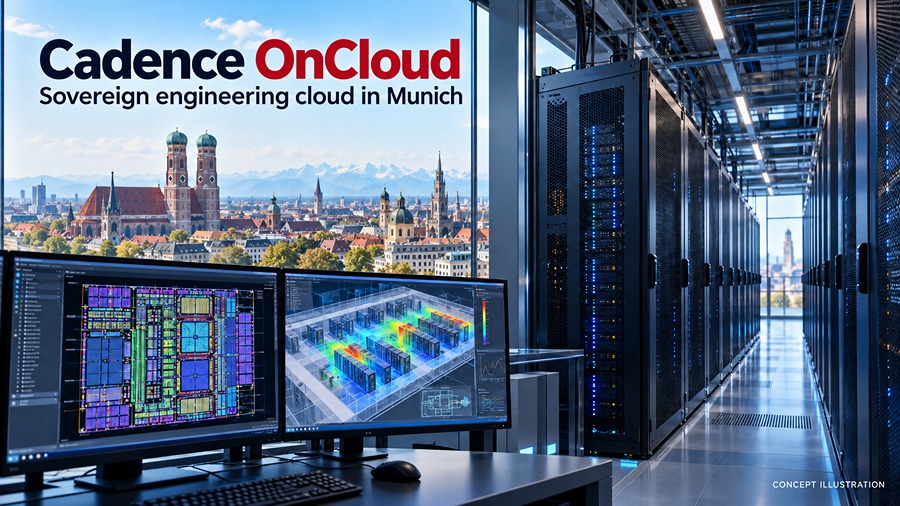
BERLIN, Germany, Oct 23, 2026 – Cadence has made its OnCloud engineering cloud service available to European customers through sovereign infrastructure in Munich. The service supports semiconductor design, simulation and AI workloads while maintaining data residency within European jurisdiction.
Cadence plans additional NVIDIA Vera and Grace CPU systems, Millennium M2000 AI Supercomputer capacity powered by NVIDIA Blackwell, and Reality Digital Twin Platform instances as part of the Munich expansion.
The Munich facility expands Cadence’s European cloud footprint and can support startups participating in EuroCDP. It complements existing European resources, including public cloud infrastructure in Frankfurt.
“Europe’s semiconductor and system design community requires secure infrastructure that enables innovation without compromising data sovereignty,” said Paul Scannell, senior vice president of the global customer success team at Cadence. “By combining NVIDIA Vera and Grace CPU platforms with the Cadence Millennium M2000 Supercomputer and making these capabilities available through Cadence OnCloud, we are providing European engineering teams with the compute, design intelligence and flexibility needed to build the next generation of AI-driven chips and systems.”
The offering combines NVIDIA accelerated computing and CUDA-X with Cadence’s AI-accelerated design and simulation software and agentic AI technologies. Its applications include chips, advanced packaging, systems, physical AI applications and AI infrastructure. As per Cadence, the combined offering allows European customers to design, build and operate sovereign AI capabilities within the European Union.
Digital Twins for Infrastructure Design
The Cadence Reality Digital Twin Platform works with NVIDIA’s AI software, including Omniverse libraries, to evaluate power delivery, cooling, airflow, thermal performance and equipment placement before deployment.
The platform supports the NVIDIA Omniverse DSX Blueprint, allowing customers to incorporate applicable blueprint capabilities into AI factory design and operational workflows. An available Reality DC Elements model represents the Millennium M2000 AI Supercomputer powered by NVIDIA Blackwell GPUs. Cadence describes it as a digital representation for simulating AI factory and data center environments before installation.
Cadence also plans to use the Reality Digital Twin Platform at its Munich facility to optimize infrastructure design and operation, with the goals of improving energy efficiency and reducing operational risk.
Partner Applications
Cadence and NVIDIA are showcasing AI factory design and operations workflows at NVIDIA GTC Berlin, combining NVIDIA accelerated computing, the Omniverse DSX Blueprint and the Millennium M2000 AI Supercomputer.
“Chip designs and AI infrastructure are strategic assets for European industry, and sovereignty means being able to develop both while protecting the data behind them,” said Tim Costa, vice president and general manager of industrial and computational Engineering at NVIDIA. “With Cadence, we’re bringing NVIDIA accelerated computing into European cloud-based design workflows and Omniverse libraries into AI factory simulation. Companies can design the silicon and validate the infrastructure to run it – from power delivery to cooling – within a European environment built to protect their design data.”
Vertiv is using the Reality Digital Twin Platform to design, simulate and validate its modular MegaMod HDX AI data center, including power, cooling and infrastructure performance before deployment.
“The Cadence Reality Digital Twin Platform helps Vertiv evaluate and optimize modular AI infrastructure before deployment, giving our teams greater confidence in design decisions and reducing risk throughout the project lifecycle,” said Viktor Petik, senior vice president, infrastructure solutions at Vertiv. “Combined with NVIDIA-powered AI systems and NVIDIA Omniverse technologies, the platform helps accelerate decision-making and deployment, enabling customers to bring AI infrastructure online more efficiently.”
HPE is adopting the platform for its HPE Data Center AI Mod POD offering to design, benchmark and operate AI infrastructure.
“By standardizing on the Cadence Reality Digital Twin Platform for our HPE Data Center AI Mod POD solution, including deployments built on NVIDIA accelerated computing, we can reduce deployment risk, optimize infrastructure utilization and help customers maximize the performance and efficiency of their AI solutions throughout the facility lifecycle. The University of Bristol’s Isambard-AI facility demonstrates what is possible when HPE’s modular, direct-liquid-cooled infrastructure and NVIDIA accelerated computing are brought together to deploy highly energy-efficient sovereign AI capacity at speed and supports the UK’s leadership in AI innovation. Cadence digital twins can build on this foundation by providing deeper insight into power, thermal, cooling, and operational performance from planning through operations,” said Pascal Lecoq, CTO and director of data center strategy office of the CTO, HPE.
France-based Nation Data Center is using the platform to design and validate sovereign, high-density AI infrastructure before deployment.
“Our ambition is to provide sovereign and responsible digital infrastructure tailored to regional needs,” said Eric Arbaretaz, CTO of Nation Data Center. “With the Cadence Reality Digital Twin Platform, we can optimize power, cooling, and thermal performance before deployment. Cadence’s validated DC Elements model for NVIDIA DGX SuperPOD with DGX GB200 systems infrastructure is particularly valuable, allowing us to accurately simulate high-density AI environments from the earliest design stages. This enables us to deliver high-performance, sustainable infrastructure tailored to our clients’ digital transformation needs.”
Source: Cadence
About Cadence

Cadence Design Systems is a U.S.-based technology firm that develops electronic design automation (EDA) tools, hardware, and IP for designing integrated circuits and electronic systems. Formed in 1988 through the merger of SDA Systems and ECAD, the company is headquartered in San Jose, CA. Cadence provides software and solutions for designing SoCs, PCBs, and complete electronic systems used in the semiconductor, automotive, aerospace and defense, telecommunications, and consumer electronics industries. Its tools support both digital and analog design workflows. Cadence employs about 12,000 people globally.
