

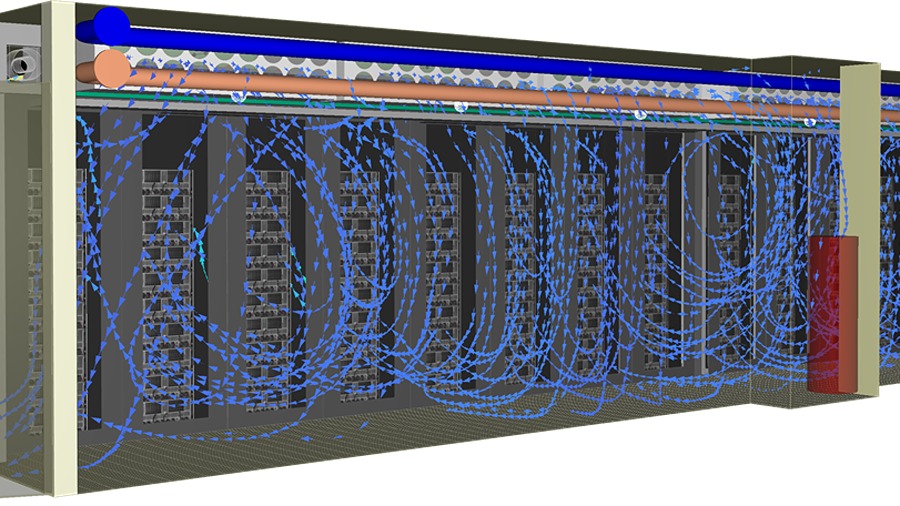
Cadence and HPE are expanding their digital twin work for data center modernization in AI and high-performance computing (HPC) infrastructure. The collaboration combines the Cadence Reality Digital Twin Platform, which virtualizes data center environments using AI, HPC, and physics-based simulation to optimize computational throughput, with HPE’s sustainable data center modernization services and expertise. HPE is standardizing the platform within its modular data center, AI Mod POD, with the goal of improving total cost of ownership, deployment speed, and operational efficiency.
Sherman Ikemoto, group director, Cadence said: “As AI reshapes data center requirements, digital twins provide a powerful foundation for designing and operating high-performing infrastructure. Working with HPE, we aim to help customers model and optimize complex environments using AI, HPC, and physics-based simulation – reducing risk while improving energy efficiency and supporting customers’ sustainability ambitions.”
Data center operators are adapting facilities for power-dense AI workloads and new cooling architectures while managing sustainability, regulatory, and service-level requirements. Cadence, NVIDIA, and HPE will provide data center blueprints, from edge to cloud, that allow customers to evaluate decisions before physical deployment, identify stranded capacity, and maintain performance as requirements change.
Paul Nelson, global director, IT Sustainability & Data Center Services, HPE added: “HPE is focused on helping customers modernize data centers for the AI era with solutions that are scalable, secure, and more sustainable. By deepening the collaboration with Cadence, we bring engineering-grade digital twin capabilities to customers, so they can optimize capacity, energy efficiency, and operational decisions across the data center lifecycle.”
Solutions for AI – and HPC-Ready Data Centers
Cadence’s digital twin solutions address data center modernization across design, deployment, and operations. The solutions are intended to help customers:
- Design AI- and HPC-ready facilities that meet power, space, cooling, and IT sustainability targets, using digital twins to validate decisions before committing to physical infrastructure and to maximize tokens-per-watt performance.
- Accelerate planning and operations for HPE Data Center Services – AI Mod POD and related AI data center solutions by using Cadence Reality DC Elements Design Library to evaluate deployment scenarios in advance. These DC elements digital models include NVIDIA GB300 NVL72 and NVIDIA Vera Rubin NVL72.
- Increase IT and facilities utilization and reduce stranded capacity through predictive modeling of power and cooling behavior ahead of configuration changes or workload shifts on the data center floor.
- Improve operational intelligence and IT sustainability by running “what-if” scenarios that support long-term capacity planning, energy optimization, and failure or upgrade planning.
By combining Cadence’s simulation and digital twin capabilities with HPE’s AI data center solutions and services, customers can plan the scaling of AI infrastructure in existing and new facilities.
The Value of Cadence Digital Twins
The Cadence Reality Digital Twin Platform enables customers to create digital replicas of data centers by dragging and dropping vendor-provided digital models that simulate the physical behavior of their counterparts. The predictive models help data center operators optimize energy efficiency, capacity, and resiliency from initial design through daily operations.
Customers can work with HPE’s data center design and engineering team, which uses the Cadence Reality Digital Twin Platform to build a physics-based layer for evaluating design trade-offs earlier and refining operations against constraints.
Source: Cadence
About Cadence

Cadence Design Systems is a U.S.-based technology firm that develops electronic design automation (EDA) tools, hardware, and IP for designing integrated circuits and electronic systems. Formed in 1988 through the merger of SDA Systems and ECAD, the company is headquartered in San Jose, CA. Cadence provides software and solutions for designing SoCs, PCBs, and complete electronic systems used in the semiconductor, automotive, aerospace and defense, telecommunications, and consumer electronics industries. Its tools support both digital and analog design workflows. Cadence employs about 12,000 people globally.
