

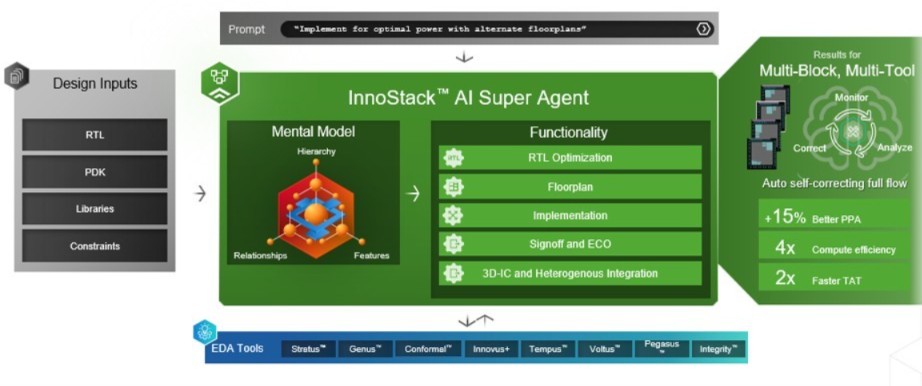
Cadence has introduced the InnoStack AI Super Agent, an agentic AI system designed to simplify digital chip implementation and signoff. By coordinating specialized AI agents across electronic design automation (EDA) workflows, the system helps semiconductor engineers evaluate design alternatives, optimize power, performance, and area (PPA), and reduce time spent managing complex implementation tasks.
Digital chip development involves interconnected decisions spanning synthesis, floorplanning, placement, routing, and verification. Changes in one stage can affect timing, congestion, or power consumption elsewhere. InnoStack addresses these challenges by translating high-level engineering objectives into coordinated tasks, running parallel experiments, and analyzing results through Cadence EDA tools.
The system supports five major areas: RTL optimization, floorplanning, physical implementation, signoff and engineering change orders (ECOs), and multi-die planning. It integrates technologies including Genus Synthesis Solution, Innovus+ Synthesis and Implementation System, Tempus Timing Solution, Voltus IC Power Integrity Solution, Pegasus Physical Verification System, and Integrity 3D-IC Platform.
Engineers can interact with InnoStack using natural language to investigate design issues, compare implementation strategies, and refine objectives. For example, when congestion near a memory macro causes timing violations, specialized agents can explore alternative placements, routing configurations, and density adjustments. Physics-based analysis and deterministic solvers validate the resulting design options.
A shared design context, domain-specialized AI models, and Cadence Native Skills help agents coordinate activities while maintaining engineering consistency across workflows.
Cadence is also collaborating with semiconductor manufacturer Rapidus to integrate agentic AI into advanced-node system-on-chip development. The collaboration targets up to a twofold improvement in design turnaround time compared with traditional workflows, although this remains a performance goal rather than a demonstrated result.
InnoStack represents a shift toward AI-orchestrated semiconductor design, allowing engineers to focus on evaluating tradeoffs and making critical decisions while automated agents handle repetitive coordination and experimentation.
