

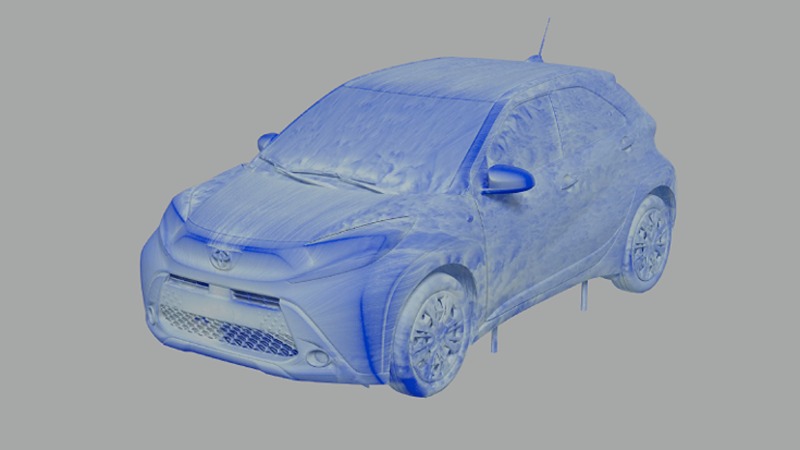
Cadence and Toyota Motor Europe (TME) are evaluating external aerodynamics and aeroacoustic simulations of the Aygo X using NVIDIA Blackwell GPUs. The work examines simulation speed and the potential to move aerodynamic and noise-suppression validation from physical testing into simulation.
The study runs Fidelity Charles Solver, the large eddy simulation (LES) solver in Cadence Fidelity CFD Software, on NVIDIA RTX PRO 6000 Blackwell Server Edition GPUs and an NVIDIA DGX B200 system. It uses a mesh configuration from a 2024 Aygo X computational fluid dynamics (CFD) benchmarking study.
Full-Vehicle Simulation
The mesh contains 178 million control volumes and applies uniform refinement across the vehicle’s complete external body. Its structure uses clipped Voronoi diagrams to resolve external aerodynamic flow features.
According to Cadence, the mesh and Fidelity Charles’ low-dissipation operators support simulation of fine-scale, unsteady flow structures relevant to aerodynamic and aeroacoustic analysis. This supports virtual wind tunnel analysis of airflow around the vehicle.
“Our collaboration with Cadence demonstrates how scalable high-fidelity CFD on NVIDIA GPUs can achieve turnaround time significantly lower than our CPU-based workflow, without sacrificing accuracy,” said Antoine Delacroix, senior manager, vehicle performance engineering R&D at Toyota Motor Europe. “Such fast aerodynamics simulation-based workflow supports our journey to make ever better cars.”
Preliminary GPU Results
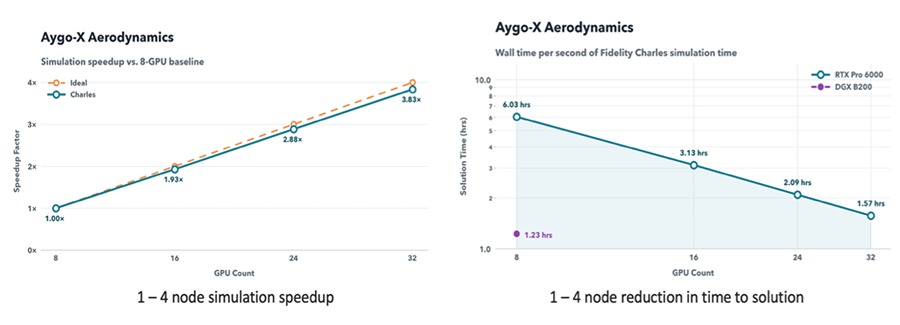
Cadence reports that increasing GPU counts reduced the elapsed computing time required for each second of simulated time. For the same Aygo X simulation, 32 RTX PRO 6000 Blackwell Server Edition GPUs approached the convergence time achieved by eight B200 GPUs, according to the preliminary results.
(Image: Cadence)
The release also reports that the eight-GPU B200 configuration reached convergence about five times faster than an RTX PRO 6000 Blackwell Server Edition configuration. It does not specify the RTX PRO 6000 GPU count used in that comparison.
Cadence describes the study as the second major stage of GPU acceleration for Fidelity Charles, progressing from the first-generation Millennium platform to the NVIDIA Blackwell-powered Millennium M2000 Supercomputer.
For comparable large-scale simulations, internal engineering estimates suggest that matching the GPU throughput with CPU-only infrastructure could require approximately 1,500 CPU cores for the RTX PRO 6000 configuration and approximately 5,000 CPU cores for the DGX B200 configuration. These are directional estimates based on a separate aircraft simulation, not measured results from the Aygo X benchmark.
“High-fidelity simulation is foundational to how automakers design, test, and refine the next generation of vehicles,” said Tim Costa, vice president and general manager of industrial and computational engineering at NVIDIA. “By accelerating the Fidelity Charles Solver’s large eddy simulations with NVIDIA CUDA-X, Cadence is helping engineers evaluate aerodynamic and acoustic tradeoffs across a broader design space and refine their designs before physical testing.”
Simulation Workflow and Future AI Models
The workflow combines Cadence BETA CAE tools with Cadence Fidelity CFD Software:
- ANSA pre-processor: Handles pre-processing.
- Fidelity Charles Solver: Performs the flow simulation on NVIDIA GPUs.
- META post-processor: Supports post-processing, visualization, reporting and automation of results.
- KOMVOS SDM console: Can manage simulation data and support predictive model development for future physics AI applications.
Cadence says running Fidelity Charles at scale with Millennium technology could support broader parametric studies and generate more varied datasets for training physics AI models.
The company describes KOMVOS as a way to retain high-volume simulation results as compact surrogates, retrieve prior simulation knowledge, compare design variants and reuse knowledge across projects. It also identifies fine-tuning pretrained physics models on targeted datasets as a potential way to reduce the new simulation data needed for accurate predictions.
“Our expanding multiphysics portfolio, coupled with NVIDIA GPU acceleration and our collaboration with Toyota, is enabling a new scale of engineering simulation for vehicle development,” said Joe Cole, corporate vice president, EMEA at Cadence. “By bringing high-fidelity physics, accelerated computing, and broader design-space exploration together, we are helping engineers evaluate more configurations and operating conditions in far less time and ultimately enabling faster convergence toward optimized vehicle designs.”
Source: Cadence
About Cadence

Cadence Design Systems is a U.S.-based technology firm that develops electronic design automation (EDA) tools, hardware, and IP for designing integrated circuits and electronic systems. Formed in 1988 through the merger of SDA Systems and ECAD, the company is headquartered in San Jose, CA. Cadence provides software and solutions for designing SoCs, PCBs, and complete electronic systems used in the semiconductor, automotive, aerospace and defense, telecommunications, and consumer electronics industries. Its tools support both digital and analog design workflows. Cadence employs about 12,000 people globally.
About Toyota Motor Europe

Toyota Motor Europe (TME) handles wholesale sales and marketing of Toyota, GR and Lexus vehicles, parts and accessories. It also manages Toyota’s European manufacturing, research, engineering and product development. TME’s sales network includes 28 national sales companies and about 2,800 retail outlets across 53 countries. Its customers include sales companies, dealerships and vehicle buyers. Operations cover vehicle sales, manufacturing, engineering, research and parts logistics. Toyota began selling vehicles in Europe through a distributor in 1963. The company established TME in Brussels in 2002 to coordinate regional sales and manufacturing. TME is headquartered in Brussels, Belgium, where its research and development center is also located. It reports more than 25,000 direct employees across Europe.
About NVIDIA

NVIDIA, founded in 1993 and headquartered in Santa Clara, CA, designs and manufactures graphics processing units, systems on chips, networking hardware, and AI intelligence software such as CUDA. Its products serve industries including gaming, data centers, autonomous vehicles, professional visualization, robotics, health care, and energy. The company introduced the GPU in 1999 and later expanded into accelerated computing and AI infrastructure. In gaming, its GPUs support high-performance rendering, while in AI and high-performance computing, its systems provide the infrastructure for training and deploying large-scale models. NVIDIA also develops tools for robotics and autonomous driving.
