

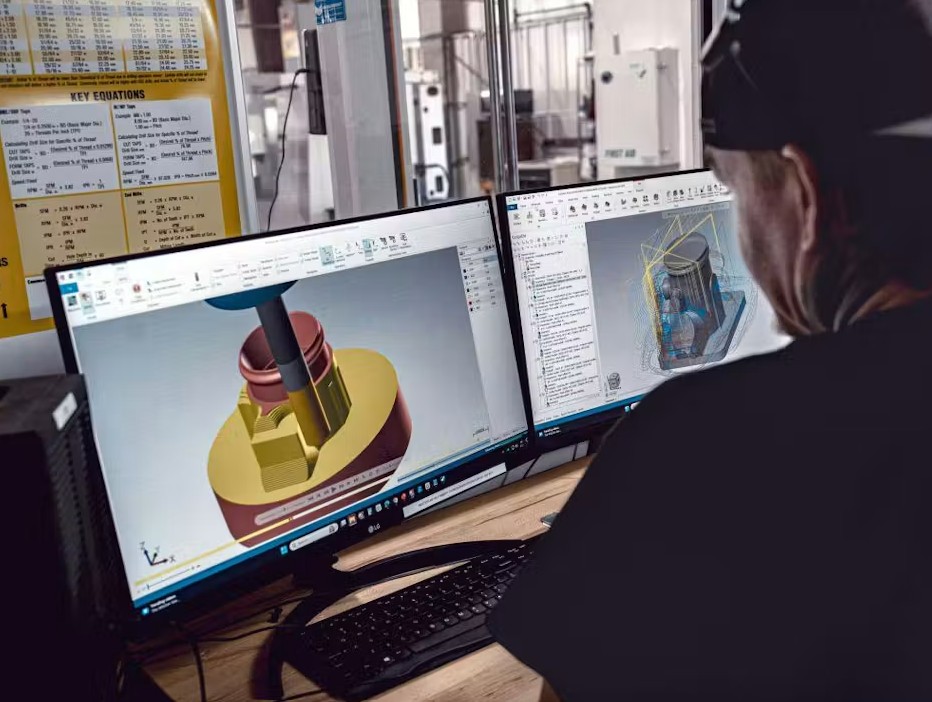
Computer-aided manufacturing (CAM) software is evolving from parameter-driven programming toward direct interaction with cutting-tool motion. Advances in visual programming, artificial intelligence, automation, and simulation are simplifying CNC workflows while preserving the expertise required for complex machining operations, tells Machine Design.
Traditionally, CNC programmers select machining strategies, configure parameters, generate toolpaths, and repeatedly adjust settings to achieve the desired results. Although effective, this process can be time-consuming, particularly when modifying specific tool movements.
According to David Conigliaro, senior product manager at Mastercam, emerging CAM technologies allow programmers to interact directly with toolpaths. Users can trim, extend, reposition, or delete individual passes, modify feeds and speeds, and adjust collision avoidance. Real-time feedback eliminates repeated regeneration cycles, making programming more intuitive.
Automation is also changing the programming process. Instead of manually defining every operation, programmers can begin with automatically generated toolpaths and refine them using their manufacturing knowledge. This approach reduces repetitive tasks while maintaining control over tolerances, tool orientation, and machining strategies.
Another development involves integrating 3- and 5-axis machining within a single workflow. Programmers can introduce multi-axis movements where necessary without switching between separate strategies, improving flexibility when machining complex components.
AI-assisted programming further simplifies workflows through natural-language interaction. Programmers can describe their objectives and receive contextual guidance without searching extensive menus or documentation. This capability could also support knowledge transfer as experienced machinists retire.
Faster simulation provides another advantage by allowing programmers to evaluate toolpath modifications continuously rather than waiting until programming is complete. Integrating simulation, AI assistance, and machining data creates a more connected development process.
The article emphasizes that automation should complement human expertise rather than replace it. By reducing software complexity and accelerating feedback, next-generation CAM systems can help manufacturers improve productivity, handle increasingly complex parts, and enable programmers to concentrate on machining quality and efficiency.
