

Chiba University researcher Hiroyuki Kubo is rethinking what cameras record before artificial intelligence analyzes an image. In a Tech Xplore Q&A, he argues that changing illumination and capture can reveal information hidden from photographs. Better data may help AI distinguish objects that look identical on the surface but differ internally.
Kubo gives the example of milk and liquid soap. Both appear as white liquids in an image, although light scatters through them differently. A camera capturing light that penetrates the material could expose those differences. His work combines optics, projectors, and cameras, and computational analysis rather than depending solely on AI models.
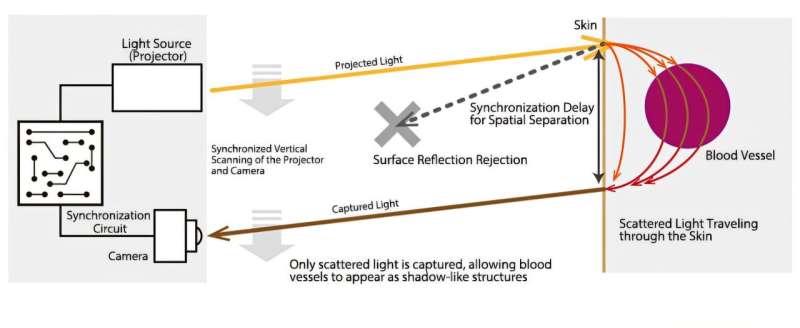
One application is imaging blood vessels beneath skin. Surface reflections normally conceal them. By separating where a projector illuminates the skin from where a camera collects light, Kubo reduces that reflection and captures light that has interacted with tissue. The method visualizes vessels in real time without radiation. Kubo sees uses in clinics, home health care, and disaster response, while AI analysis might assist with vascular diagnosis.
He describes a method for revealing water flow. Cellulose nanofibers dispersed in water align as it moves, changing the polarization of scattered light. Imaging that pattern reveals flow direction. Combined with AI, such measurements could inform infrastructure maintenance, ship design, or swimming analysis.
Kubo’s second research area is anime production. Early attempts to color line drawings proved too error-prone for a process in which small mistakes matter. His system proposes candidate colors and lets an artist choose among them, reducing work while preserving human judgment.
Across both efforts, Kubo treats AI as part of a system. Physical measurements can supply evidence for analysis, while human artists can make creative decisions. His research highlights the value of designing the capture and workflow around the problem rather than expecting software to solve it.
