

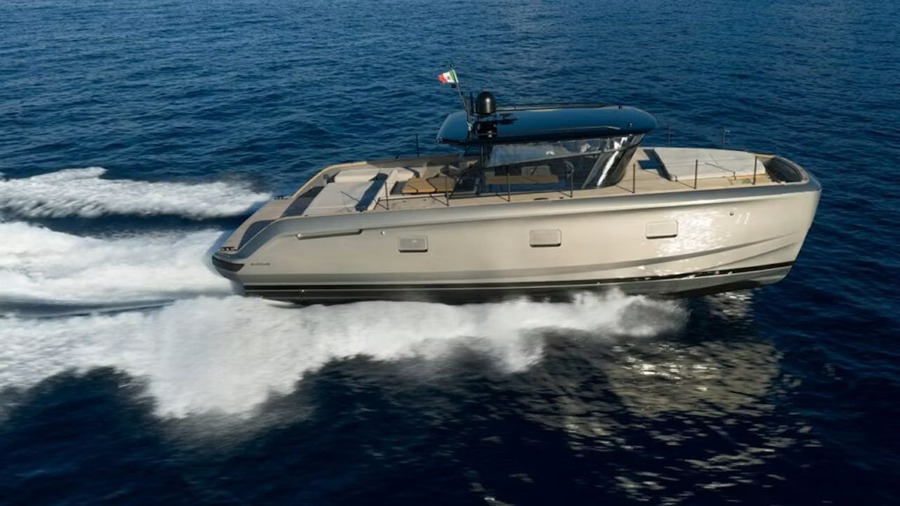
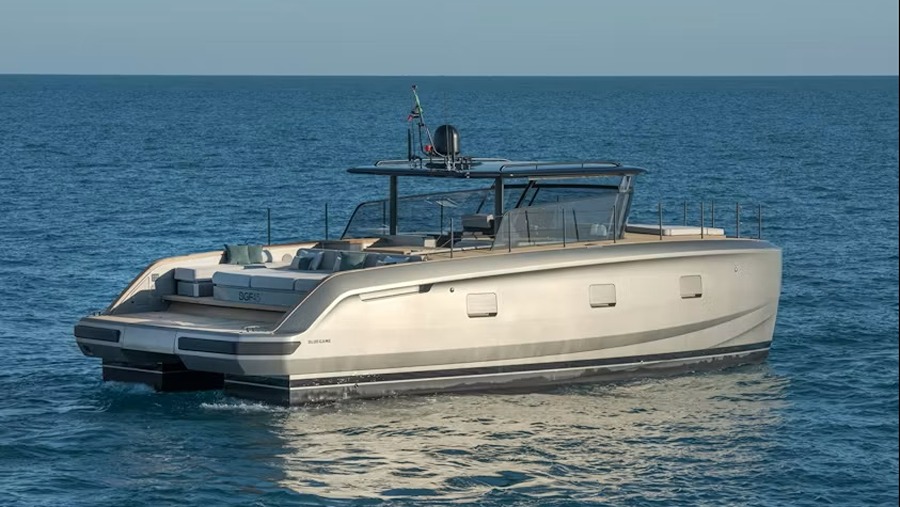
PLANO, TX, Oct 1, 2026 – Caponnetto Hueber used Siemens Simcenter software to develop the foil-assisted design of Bluegame’s BGF45, a 45-foot leisure catamaran capable of exceeding 35 knots. Siemens reports fuel consumption reductions of up to 30% compared with a catamaran without foils.
The project continues Caponnetto Hueber’s collaboration with Bluegame shipyard, part of Italy’s Sanlorenzo Group. Caponnetto Hueber used Simcenter to evaluate hydrodynamic performance, stability and comfort.
“Applying our hydrodynamic expertise, built in our America’s Cup work, to a commercial vessel requires powerful simulation tools. Siemens’ Simcenter technology allowed us to evaluate concepts quickly, refine the foil‑assisted architecture and give Bluegame a design that delivers measurable gains in efficiency and comfort,” said Mario Caponnetto, co-founder and technical director, Caponnetto Hueber. “By combining our racing experience backed up with the Siemens’ advanced simulation technologies, we were able to bring innovation to the BGF45 that simply wouldn’t be achievable through traditional methods.”
“Shipyards must deliver meaningful performance improvements without adding operational complexity for customers. Simcenter’s simulation and digital‑twin capabilities allowed the BGF45 engineering teams to validate design decisions early and optimize hydrodynamic behavior across real‑world ocean conditions,” said Mike Croegaert, director of marine solutions – simulation, Siemens Digital Industries Software. “This collaboration demonstrates how advanced simulation can bring racing‑grade innovation to commercial vessels.”
Foil Design and Simulation
Caponnetto Hueber and Bluegame adapted learnings from their 50-knot, hydrogen-powered foiling catamaran for the 37th America’s Cup. According to Siemens, this arrangement eliminates the need for expensive lift-control systems while reducing drag by up to 30%.
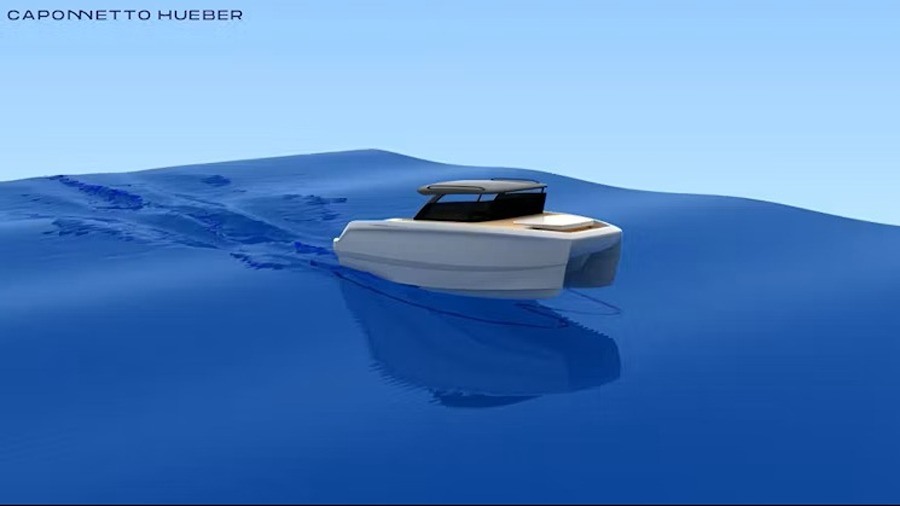
Caponnetto Hueber used Simcenter structural simulation software and Simcenter STAR-CCM+ CFD software to analyze structural behavior, seakeeping, maneuvering and fluid-structure interactions. Visualizations showed wave impacts, turning trajectories and vortex behavior between the foils and hull. Caponnetto Hueber engineers and Bluegame used these results to evaluate design decisions.
Electrical Monitoring
Siemens SENTRON products also form part of the BGF45’s electrical system. Integrated monitoring functions support the management of energy flows aboard the yacht.
Source: Siemens
About Siemens Digital Industries Software

Siemens Digital Industries Software, a business unit of Siemens AG, provides industrial software, hardware and related services through the Siemens Xcelerator platform. The company’s portfolio includes product lifecycle management, electronic design automation, simulation and digital twin tools, manufacturing operations management and low-code application development. These products support design, engineering and production workflows across sectors such as aerospace and defense, automotive, electronics and semiconductors, machinery, medical devices and process manufacturing. Siemens Digital Industries Software traces its origins to 1963 as United Computing, later becoming Siemens PLM Software in 2007 before adopting its current name. It supplies technologies that help organizations manage product, process data, and improve development and manufacturing efficiency across a range of industrial applications.
About Caponnetto Hueber

Caponnetto Hueber is a naval engineering consultancy headquartered in Valencia, Spain. Co-founder Mario Caponnetto started the company with Francis Hueber in 2016. The firm designs and evaluates yachts, ships, hydrofoils, propulsion systems and surface vessels. Its services include computational fluid dynamics, naval architecture, performance modeling, prototyping and sea-trial support. Engineers model hull, sail and propeller performance using potential-flow codes, RANS, large-eddy simulation and direct numerical simulation. The company serves yacht builders, shipyards, racing teams, maritime transport operators, shipping companies and defense organizations. Its projects include racing yachts, commercial vessels, maritime decarbonization and wind-assisted propulsion. It also works on autonomous surface vessels and marine renewable-energy research. In 2024, the firm delivered hydrodynamic and foiling design for a hydrogen-powered America’s Cup chase boat. A year later, it supported Bluegame’s BGF45 foiling-yacht development, including hull-foil interaction and stability simulations.
