

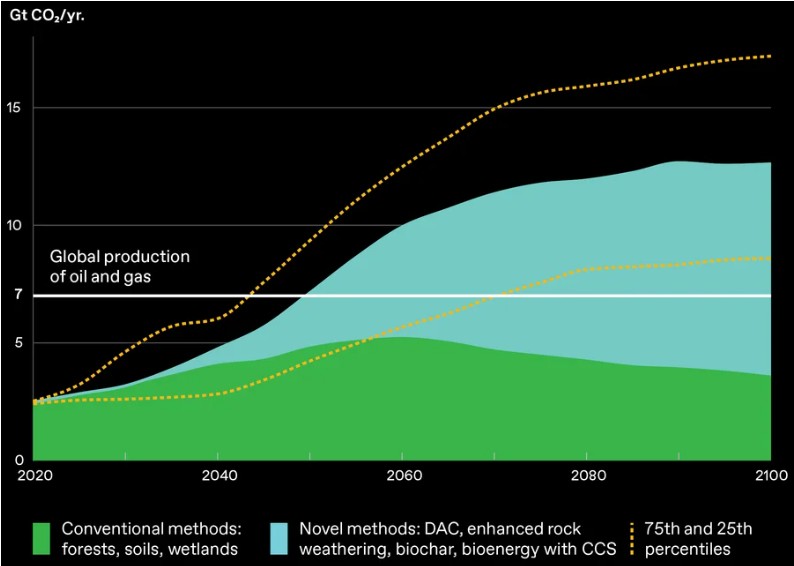
Global greenhouse gas emissions continue to rise, putting the goal of limiting warming to 1.5–2°C under threat. To hit those goals, society must not only cut emissions but also remove vast amounts of carbon dioxide (CO₂) from the atmosphere. IEEE Spectrum’s analysis highlights the scale of the task: about 9 gigatonnes (Gt) of CO₂ have already been removed since 2019, but an estimated 525–755 Gt more will need to be sequestered by 2100 through a mix of conventional and novel methods.
Conventional methods, such as planting forests or storing more carbon in soils, are inexpensive and widely used, but each has limits. Forests burn, soils saturate, land competes with agriculture, and carbon stored naturally can escape due to disease, climate stress, or poor management.
Novel methods include direct air capture (DAC), enhanced rock weathering, biochar, and others. Currently, these are very small scale: together they remove only a few million tonnes per year, tiny compared to the gigatonne scale needed. DAC makes up only a sliver of that.
Scaling DAC and other technologies to remove 6–12 Gt/year by 2100 is a common requirement in IPCC scenarios to help balance residual emissions from agriculture, industry, and other hard-to-decarbonize sectors. But doing so will require huge increases in clean energy supply, infrastructure for capture and deep injection (underground storage), and improvements in economics, efficiency, and environmental safety.
Another concern: many DAC systems today consume large amounts of energy or reagents, sometimes creating adverse by-products. If not done thoughtfully, scaling could undermine benefits. Also, storage capacity isn’t a barrier: there’s enough subterranean space identified globally to store CO₂ for centuries, assuming safe and secure practices.
Carbon capture at the gigatonne scale is technically plausible, but only if deployment ramps up fast, costs drop, and energy sources are clean. Otherwise, large-scale removal might become one of the biggest engineering and policy challenges of our generation.
