

MIT researchers have directly observed how carbon dioxide changes the chemistry of fresh cement paste, offering new insight into a process already attracting commercial interest for storing CO₂ in concrete. The study, published in the Journal of the American Ceramic Society, was led by MIT Associate Professor Admir Masic, with graduate student Marcin Hajduczek as first author. The team also included researchers from IIT Jodhpur and CarbonCure Technologies.
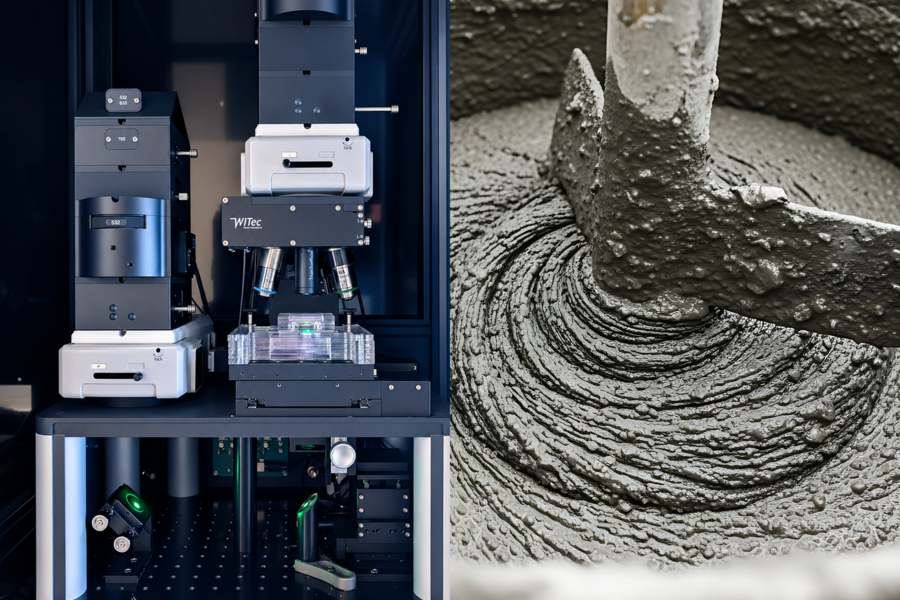
To track the reaction, the researchers blended solid CO₂ flakes into cement paste, sealed the samples, and monitored them for 24 hours using Raman confocal microscopy. This laser-based technique allowed them to identify fleeting chemical phases that previous methods could not capture.
The team found that CO₂ injection sets off a three-stage process. First, the CO₂ dissolves into the pore solution and reacts with calcium released by clinker, forming calcium carbonate within the first hour. This temporarily slows normal hydration by removing calcium from the system. Without enough calcium nearby, silicates dissolve and spread through the paste, forming an interconnected silica gel network.
After about four to five hours, once the injected CO₂ is mineralized, hydration resumes. Calcium hydroxide forms and reacts with the silica gel, producing calcium silicate hydrate, or C-S-H, the main binding phase in cement. Unlike conventional C-S-H, which forms around clinker particles, this binder develops more evenly throughout the cement matrix. By eight hours, the silica gel has largely disappeared, transformed into additional C-S-H.
The result is a stronger early-age microstructure. Cement paste containing CO₂ at 1% by cement weight achieved 13% higher compressive strength after 24 hours than reference mixes. The findings also challenge the earlier belief that calcium carbonate crystals seed C-S-H growth; instead, they appear to be passive particles within the silica gel template. Researchers say the next step is to refine dosage and study the mechanical properties of this newly observed pathway.
