

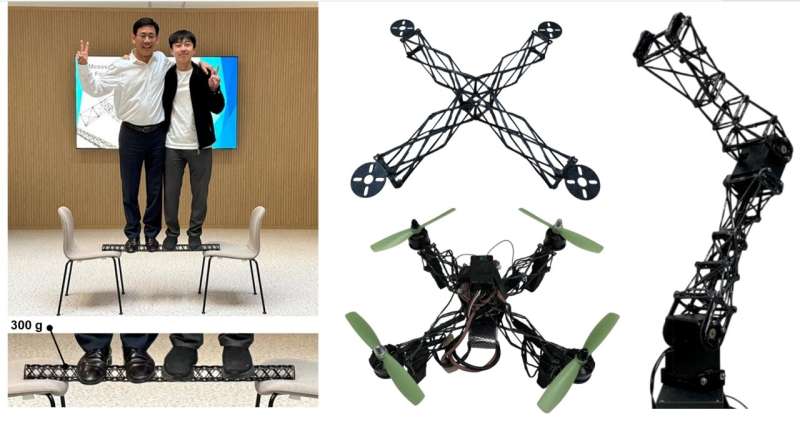
A new class of ultralight structural materials developed by researchers at Seoul National University challenges long-standing assumptions about strength and weight in engineering design. The study introduces carbon fiber lattice structures that match the strength-to-weight performance of aluminum while weighing as little as one-hundredth as much, tells Tech Xplore.
The breakthrough lies in a fabrication method called 3D node winding, which replaces conventional layered or assembled construction with a continuous fiber architecture. Traditional carbon fiber composites rely on stacking thin layers or joining multiple parts, creating weak interfaces that limit performance and design flexibility. By contrast, the new approach uses a single, continuous carbon fiber wound through a three-dimensional scaffold, forming a unified lattice structure. This eliminates joints and enables uninterrupted load transfer throughout the material.
Mechanically, the lattices demonstrate compressive strengths in the range of 10–30 megapascals, comparable to construction materials such as concrete. While not exceeding the absolute strength of metals, their efficiency relative to weight is exceptional. At equal mass, the structures can outperform conventional lattice systems by up to 10 times, largely due to more efficient force distribution and reduced inactive material.
The research also validates real-world applications. When used in a drone frame, the lattice design reduced structural weight by nearly 80%, leading to a 33% increase in flight time. These results highlight how weight reduction directly translates into improved system performance, particularly in mobility and aerospace applications.
Beyond performance gains, the work signals a broader shift in manufacturing philosophy. Instead of assembling discrete components, engineers can design structures as continuous systems defined by geometry and fiber pathways. This approach aligns well with robotic fabrication techniques, suggesting a scalable path toward complex, high-performance materials.
The development points toward a future where lightweight, efficient structures are not limited by traditional manufacturing constraints but are instead shaped by design-driven, integrated fabrication methods.
