

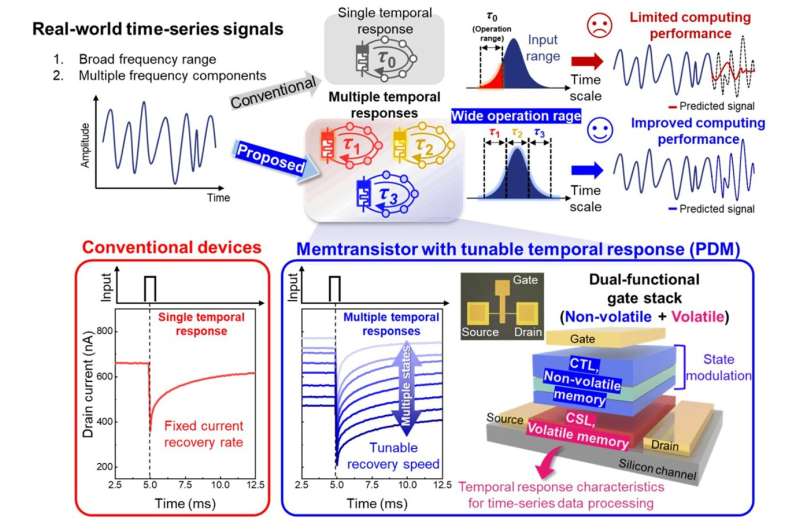
Researchers at the Korea Advanced Institute of Science and Technology (KAIST) have developed a programmable semiconductor that can adjust its response characteristics to process data changing at different speeds. Called a programmable dynamic memtransistor (PDM), the device could improve real-time AI processing in autonomous vehicles, robots, and wearable electronics, tells Tech Xplore.
Conventional computers rely heavily on software to analyze time-series data, such as movement or handwriting, which can change at different rates. This processing increases computational demands and power consumption. Hardware-based approaches offer an alternative, but conventional semiconductor devices typically have fixed response speeds once manufactured.
The PDM addresses this limitation through a dual-layer transistor structure. A charge storage layer processes incoming information, while an electron trapping layer controls how quickly the device returns to its original state. This arrangement allows the transistor’s temporal response to be programmed across multiple levels and retained without continuous external power.
In experiments, researchers adjusted the device’s current recovery time across an approximately fivefold range and its characteristic frequency across more than a 10-fold range. When processing signals containing a combination of fast and slow changes, PDM arrays reduced prediction errors by more than 40-fold compared with devices using a single fixed temporal response. For multivariate chaotic signals, errors fell by more than fourfold.
The researchers also fabricated an integrated PDM array capable of processing multiple time-series signals simultaneously. Tests showed that it achieved prediction accuracy comparable to conventional software-based systems while consuming considerably less energy.
Another advantage is manufacturing compatibility. The PDM uses materials already employed in commercial semiconductor processes, potentially simplifying future mass production.
The researchers believe programmable response characteristics could make AI hardware more adaptable to real-world signals while reducing preprocessing and energy requirements. The technology could ultimately support more efficient AI systems that must interpret rapidly changing information directly on devices.
