

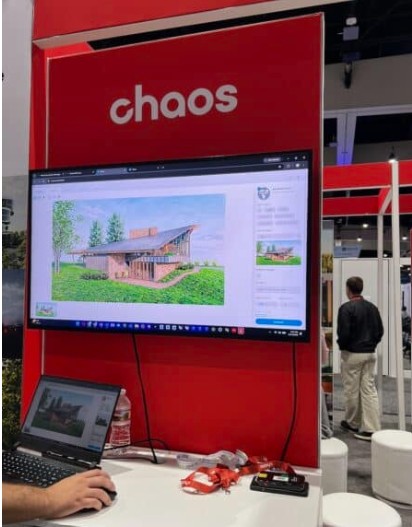
Chaos used AIA26 to demonstrate how its expanding portfolio of visualization and design tools is helping architects move more efficiently from concept to presentation. Long recognized for its V-Ray renderer, the company now offers a broader ecosystem that includes Enscape, Corona, Veras, Envision, and productivity tools such as Glyph, Morphis, and Helix. The Architosh report highlights Chaos as one of the AEC software industry’s major players, alongside Autodesk, Trimble, and the Nemetschek Group, reflecting its growing influence beyond rendering alone.
The spotlight at the conference remained firmly on visualization. Enscape continues to serve as Chaos’ primary real-time rendering platform for architects, supporting leading BIM applications including Autodesk Revit, SketchUp, Archicad, and Vectorworks. Recent enhancements remove the previous 2 GB scene-size limitation, allowing users to work with much larger and more complex projects. Additional features include AI-powered material generation, image upscaling, and a one-click live link to Chaos Envision, creating a smoother transition from design review to high-quality visualization.
V-Ray also received major upgrades with the release of V-Ray 7. New capabilities include GPU-based caustics, a rendering profiler that identifies scene bottlenecks and recommends performance improvements, and support for Gaussian Splats. These additions help visualization specialists produce more realistic images while reducing rendering times. Corona 15 similarly advances its workflow by integrating Veras AI across all subscription levels, enabling architects to generate material variations, seasonal changes, and animations directly from rendered scenes. Improvements to global illumination and material effects further enhance image realism.
Perhaps the most significant development is the deeper integration of Veras throughout the Chaos ecosystem. Veras 4.0 uses Google Nano Banana Pro to improve geometry accuracy, lighting, and material realism while reducing common AI image artifacts. It can transform sketches, 2D drawings, and early-stage models into presentation-quality renderings, generate multiple viewpoints from a single image, and even create short animations. These capabilities accelerate design exploration without requiring architects to rebuild geometry, making AI a practical part of everyday visualization workflows.
The article concludes that Chaos is steadily evolving from a rendering software provider into a connected design platform. By combining AI-assisted visualization, cloud collaboration, real-time rendering, and integrated workflows, the company is giving architects faster ways to communicate ideas while maintaining the precision needed for professional practice.
