

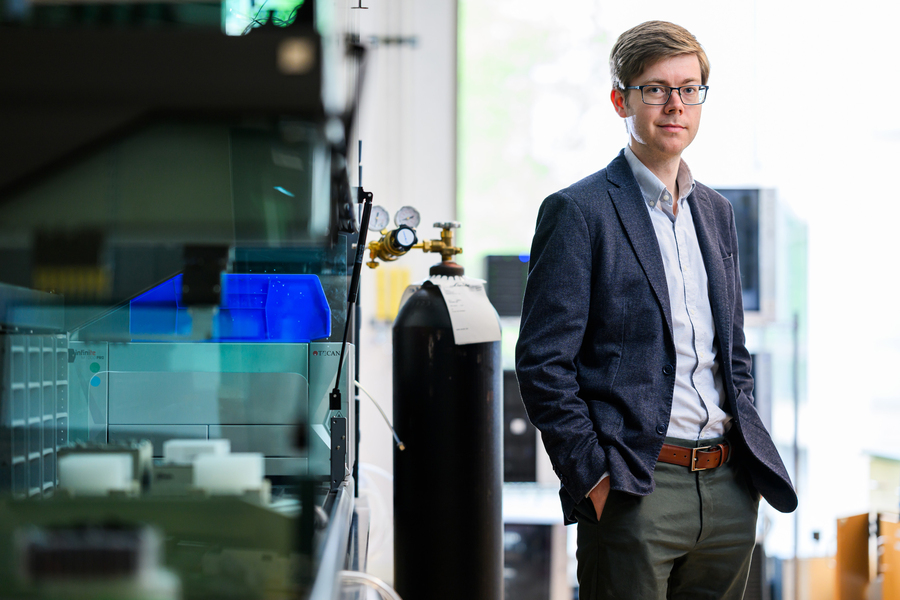
A report from MIT News examines the work of MIT researcher Connor Coley, whose team is developing artificial intelligence systems that incorporate established chemical knowledge rather than relying entirely on data-driven pattern recognition. The approach aims to make AI models in chemistry more accurate, interpretable, and scientifically reliable.
Traditional machine learning systems often depend on massive datasets to identify correlations, but chemistry presents unique challenges because experimental data can be limited, noisy, or expensive to obtain. Coley’s research focuses on embedding physical laws, reaction mechanisms, and molecular constraints directly into AI models so that predictions align more closely with real chemical behavior. By integrating domain expertise with computational learning, researchers hope to reduce errors and improve the practical usefulness of AI-generated insights.
The article highlights applications ranging from drug discovery to materials science and chemical synthesis planning. AI systems can already suggest possible molecular structures or reaction pathways, but purely statistical models sometimes generate chemically implausible results. Incorporating chemical principles helps narrow the search space and guides models toward outcomes consistent with known scientific rules.
Another important theme is interpretability. Scientists are often hesitant to trust black-box AI systems when working in high-stakes research environments. Models grounded in chemical reasoning may offer explanations that researchers can evaluate, verify, and refine more easily. This could strengthen collaboration between human scientists and machine-learning systems rather than positioning AI as an opaque replacement for expertise.
The work also reflects a broader shift occurring across scientific AI development. Researchers increasingly recognize that successful scientific machine learning may require hybrid systems combining empirical data, theoretical frameworks, and physical constraints. Instead of replacing scientific understanding, AI becomes a tool that operates within it.
The article presents Coley’s research as part of a growing effort to build AI systems capable of contributing meaningfully to scientific discovery while remaining anchored in the underlying principles that govern the physical world.
