

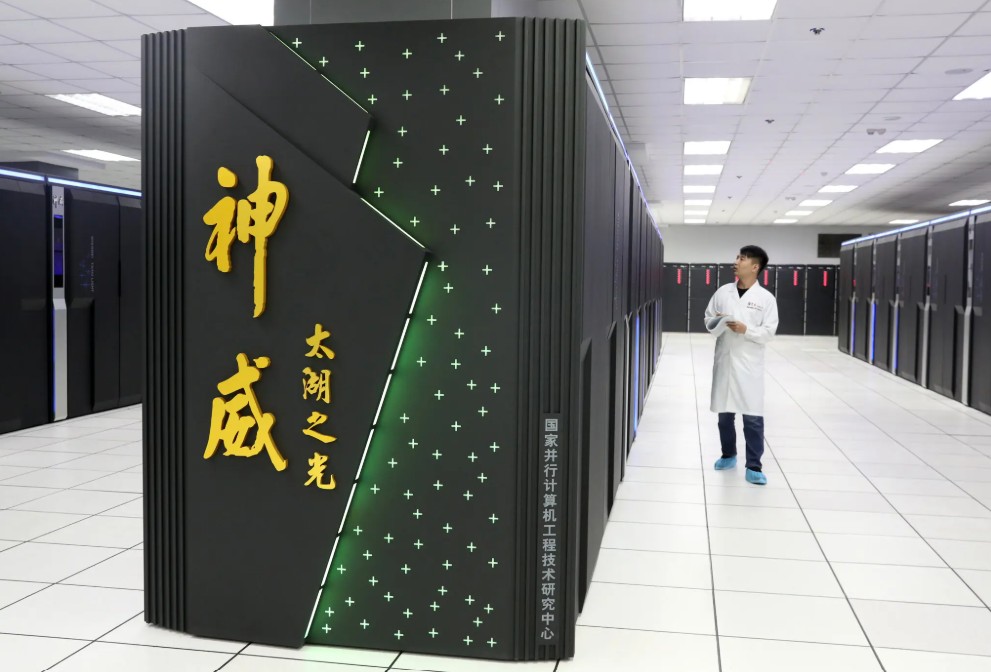
China has reclaimed the top position in global supercomputing with LineShine, a new system developed at the Shenzhen Cloud Computing Center that has surpassed the performance of the United States’ leading supercomputer, El Capitan. According to benchmark results used for the Top500 ranking of the world’s most powerful supercomputers, LineShine delivers more than 20% higher performance, marking China’s return to the No. 1 position for the first time since 2017, tells The New York Times.
What distinguishes LineShine is not only its speed but also its architecture. Unlike most modern supercomputers, which depend heavily on graphics processing units (GPUs) for demanding calculations, LineShine relies primarily on standard central processing units (CPUs). The system incorporates specialized circuitry within its processors to accelerate matrix and vector operations, tasks that are traditionally assigned to GPUs. This integrated design could offer a new model for combining artificial intelligence workloads with conventional scientific computing.
The achievement carries significance beyond technical performance. The United States has imposed restrictions on advanced AI chip exports to China in an effort to limit access to cutting-edge computing technology. LineShine demonstrates that Chinese researchers can pursue alternative architectural approaches that reduce dependence on restricted GPU technologies while still achieving world-class performance.
The system contains nearly 14 million computing cores housed in 90 hardware cabinets. Its processors are based on an architecture licensed from Arm Holdings, whose technology has become increasingly important in data centers and high-performance computing environments. While details about the chip manufacturer and fabrication process remain undisclosed, experts view the accomplishment as evidence of China’s growing capability in advanced computing.
The development also highlights the evolving relationship between traditional supercomputing and artificial intelligence. While AI systems often use lower-precision calculations for speed, scientific simulations continue to require the high-precision mathematics associated with conventional supercomputers. LineShine’s architecture seeks to bridge these two worlds.
Already, the system has been used for large-scale Earth simulations and complex brain modeling projects. Its success underscores the strategic importance of supercomputing in science, national security, climate research, and artificial intelligence, while reinforcing the intensifying technological competition between China and the United States.
