

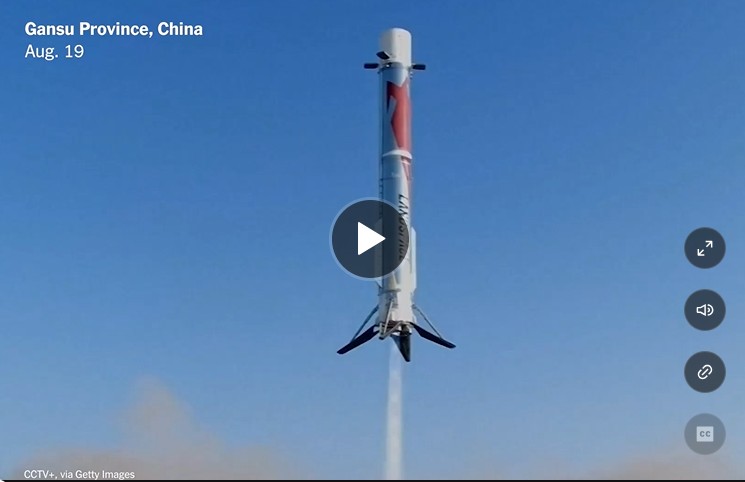
China has reached an important milestone in reusable rocket technology after private aerospace company LandSpace successfully landed the first stage of a rocket that had traveled to space. The achievement could help China reduce satellite launch costs and narrow the technological gap with the United States, tells The New York Times (full article available to subscribers).
LandSpace’s Zhuque-3 rocket separated its first and second stages about 2 minutes and 20 seconds after liftoff. The first stage then returned safely to a designated recovery site in Gansu Province. The landing followed another Chinese achievement in July, when the state-owned China Academy of Launch Vehicle Technology recovered a Long March 10B first stage using nets on a vessel in the South China Sea.
Reusable boosters are critical to lowering launch costs because they reduce the need to manufacture a new rocket for every mission. SpaceX demonstrated this potential when it first landed a Falcon 9 booster in 2015. Today, Falcon 9 rockets routinely fly with reused boosters, enabling SpaceX to launch satellites at a high frequency. Blue Origin has also successfully landed a New Glenn booster.
China remains well behind the United States in reusable launch capabilities. However, successful recoveries by two separate Chinese organizations suggest the country is making progress toward commercially viable reusable rockets.
The technology could also support China’s broader ambitions in satellite communications. SpaceX operates more than 10,000 Starlink satellites, representing about two-thirds of active satellites in orbit. China’s two competing constellations currently have only about 400 satellites combined.
Cheaper, more frequent launches could accelerate their deployment and potentially create an alternative to Starlink in international markets.
Still, individual successes do not establish a dependable reusable launch system. Chinese companies must demonstrate that boosters can be recovered, refurbished, and relaunched repeatedly. Doing so could strengthen China’s commercial space sector while supporting its larger goal of becoming a leading global space power.
