

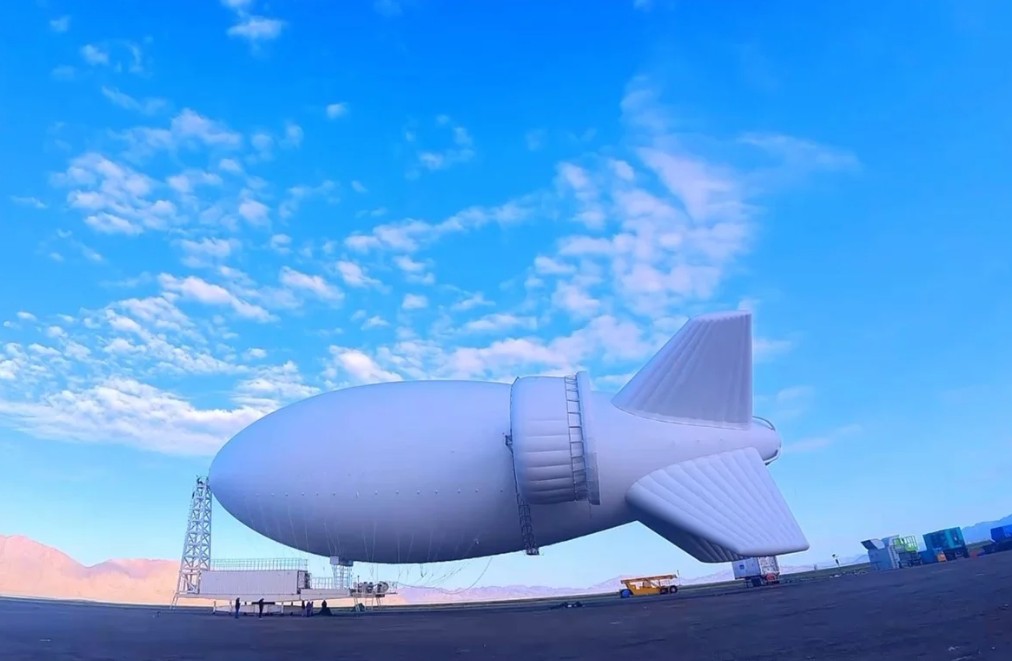
China has tested an airborne wind energy system that climbed to 4,000 meters, or 13,123 feet, above sea level and generated electricity using high-altitude winds. State broadcaster CCTV described the demonstration as a world first and an important step toward deploying airborne wind power at an engineering scale, tells South China Morning Post.
The S4000 prototype completed an entire operating cycle at a test site in northwestern China. This included ascent, maintaining its position at altitude, generating electricity, and returning to the ground. The system was developed by Beijing-based Sawes Energy Technology in collaboration with Tsinghua University and the Aerospace Information Research Institute of the Chinese Academy of Sciences.
Roughly as long as a Boeing 747, the S4000 resembles a large airship. Helium provides lift, allowing the craft to carry lightweight wind turbines thousands of meters above the surface. At these altitudes, winds can be stronger and more consistent than those available to conventional ground-based turbines. Electricity generated by the turbines is transmitted to the ground through a tether connecting the aircraft to its operating site.
Mobility could provide another advantage. Unlike conventional wind farms that require permanent towers and substantial infrastructure, airborne systems could potentially be relocated between sites. This could make them useful for supplying electricity in deserts, highlands, islands, and disaster areas where conventional grid infrastructure is unavailable or difficult to build.
The S4000 follows earlier Sawes prototypes. The company flew its S1500 system in September 2025, making it the first of its aircraft to achieve 1 megawatt of power output. It subsequently tested the S2000 at an altitude of 2,000 meters in January 2026.
Commercial interest is already emerging. According to Sawes, orders for the S1500 and S2000 had reached nearly 500 million yuan, or about $74.3 million, by March.
