

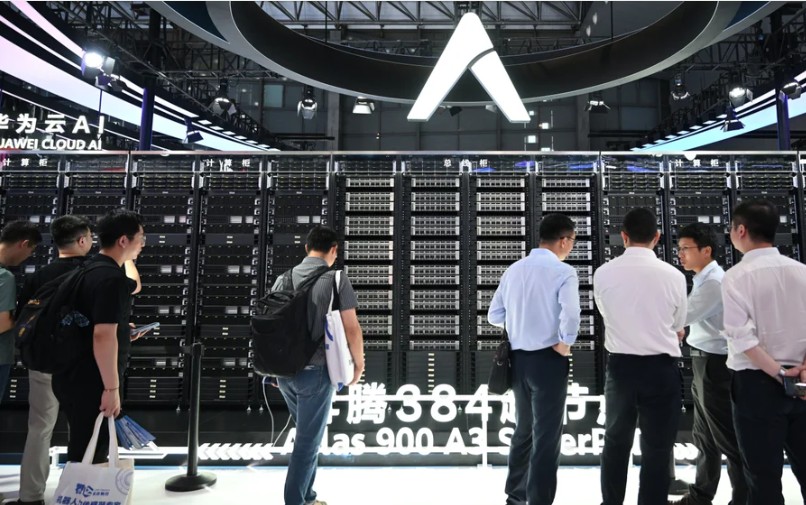
China’s technology firms and government are intensifying efforts to reduce reliance on Nvidia’s GPUs as the backbone of the country’s AI development. For years, Nvidia GPUs powered China’s AI ecosystem, running large language models, video apps, search engines, and electric-vehicle systems. But escalating export controls and growing political pressure have pushed China’s major players, such as Huawei Technologies Co., Ltd., Alibaba Group Holding Limited, Baidu, Inc., and Cambricon Technologies Corporation, into an “only-China” AI-chip race, tells IEEE Spectrum.
Huawei’s Ascend chip line leads the charge: the Ascend 910B, and its forthcoming 910C, aim toward performance levels comparable to older Nvidia models. However, Huawei still trails Nvidia’s most recent offerings, especially in memory bandwidth and software-ecosystem maturity. Alibaba is building its own inference-focused AI chips, such as its PPU, which support large memory and PCIe 5.0 connections and are pitched as rivals to Nvidia’s H20. Baidu has revealed its third-generation P800 chip cluster, claiming around 345 TFLOPS at FP16 and promising annual updates through the next few years. Cambricon, once faltering, now looks more competitive thanks to its MLU series, and may soon approach Nvidia-level performance.
But matching Nvidia involves more than raw compute. The article highlights challenges in memory, interconnect bandwidth, software tools (such as CUDA equivalents), manufacturing scale, and ecosystem trust. At its core, though, the move is geopolitical: China sees dependence on U.S. technology as a vulnerability, and the United States views chip controls as levers of national security. In short, China no longer wants to play second fiddle in the global AI-hardware race, and its tech titans are racing to fill the void.
