

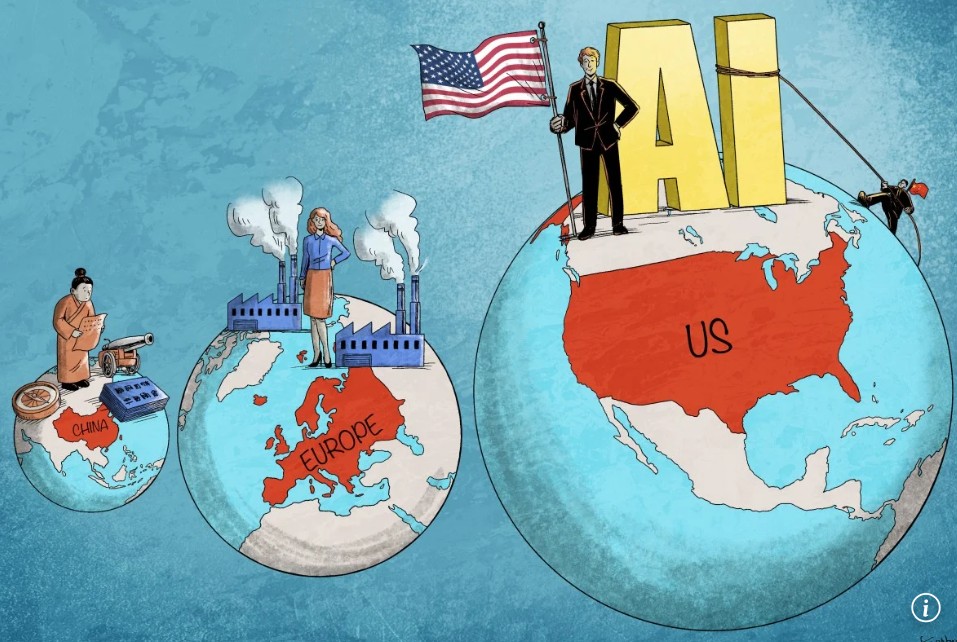
China’s rapid progress in artificial intelligence is forcing policymakers, researchers, and businesses to reconsider long-standing assumptions about global technological leadership. According to the South China Morning Post article, the country’s achievements in AI, electric vehicles, robotics, and advanced manufacturing have transformed it from a technology follower into a major innovator, raising questions about whether the United States can maintain its traditional leadership in the next industrial revolution.
The article frames this shift through a modern reinterpretation of the historic “Needham Question,” which asked why China, despite centuries of scientific leadership, did not lead the Industrial Revolution. Today, scholars are asking the opposite question: Why has China become such a powerful force in science, engineering, and innovation? According to experts cited in the article, China’s success stems from sustained investment in research, education, manufacturing, and industrial ecosystems rather than relying solely on copying foreign technologies.
China’s AI development is also benefiting from its extensive manufacturing capabilities. Unlike many countries where AI advances remain concentrated in software, China has integrated AI with hardware industries, including robotics, autonomous vehicles, consumer electronics, and factory automation. This combination enables rapid testing, production, and commercialization of new technologies. As a result, AI innovations can move from laboratories to large-scale deployment more quickly, creating a competitive advantage in industrial applications.
The article argues that the growing recognition of China’s technological capabilities represents a broader “AI reckoning” for the West. Long-held beliefs about American exceptionalism in innovation are increasingly being challenged as Chinese companies produce competitive AI models, advanced electric vehicles, industrial robots, and semiconductor technologies. International investors and policymakers are now visiting Chinese factories to better understand the country’s manufacturing strength and innovation ecosystem.
Rather than portraying the competition as a race between individual AI models, the article suggests the real contest centers on industrial capacity, supply chains, talent, and the ability to translate research into commercial products. As AI becomes a foundational technology across multiple industries, China’s integrated approach to innovation may reshape the balance of global technological leadership and redefine the next phase of industrial development.
