

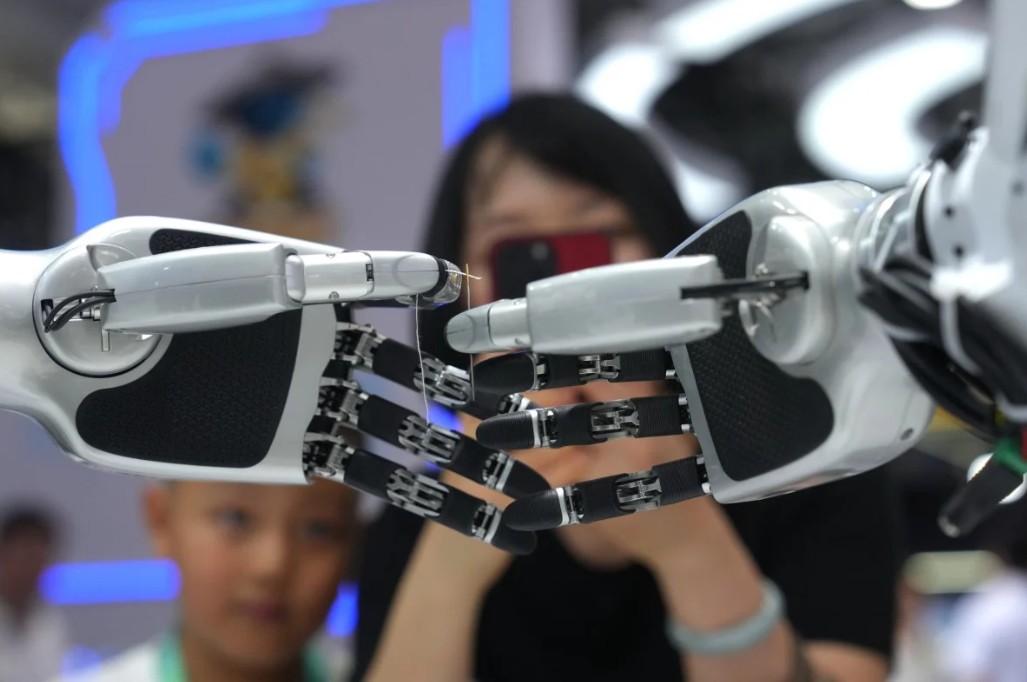
Humanoid robots continued to attract crowds at the 2026 World Robot Conference in Beijing, but Chinese robotics companies are increasingly emphasizing machines designed for practical work rather than flashy demonstrations. The shift suggests that commercial robotics may not depend on giving every machine a humanlike form, tells South China Morning Post.
At Unitree Robotics’ booth, bipedal robots demonstrated their speed, balance, and coordination by playing table tennis and taking part in fighting matches. Elsewhere at the conference, however, robots performed less theatrical but more commercially relevant tasks, including sorting parcels, loading production lines, and moving materials. Many of these machines relied on wheels and conventional robotic arms instead of legs.
For industrial customers, practical performance can matter more than whether a robot resembles a person. Yang Li, a senior engineer at Chinese startup X Square Robot, said customers focus on factors such as payload capacity, reliability, and return on investment. His point raises a fundamental design question: If wheels can perform a job efficiently, two legs may add unnecessary complexity.
X Square Robot highlighted this approach with WALL-B, its two-armed embodied robot. In a controlled one-hour test, the company said WALL-B sorted 1,816 packages. By comparison, X Square said Figure AI’s bipedal Figure 03 robot handled an average of 1,248 parcels per hour. The figures illustrate the potential advantages of designing robots around specific working environments rather than reproducing the human body.
AI2 Robotics demonstrated another approach with a wheeled robot that prepared coffee and ice cream for conference visitors. Instead of identical hands, the robot used different end effectors, including a gripper on one arm and a dexterous hand on the other.
The trend does not mean humanoid robots are disappearing. Rather, China’s robotics industry appears to be entering a more pragmatic phase in which deployment, productivity, and economics increasingly influence robot design. The machine that succeeds commercially may ultimately be the one best suited to the job, regardless of whether it looks human.
