
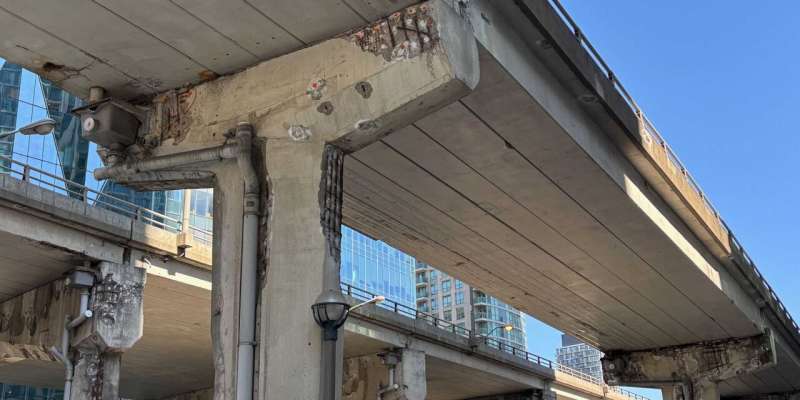
Lower-carbon concrete could help reduce construction-related emissions, but concerns about its long-term durability have slowed adoption. New research from ETH Zurich suggests current standards may be overlooking an important factor. Local climate, particularly changing moisture conditions, can influence steel corrosion far more than the concrete mixture itself, tells Tech Xplore.
Lower-carbon concrete often carbonates faster than conventional concrete. During carbonation, atmospheric carbon dioxide penetrates the material and changes its chemistry, eventually reducing the natural protection surrounding reinforcing steel. Current building standards focus heavily on delaying this process, potentially putting lower-carbon cement formulations at a disadvantage.
ETH researchers argue that the more important question is what happens after carbonation reaches the steel. Their modeling indicates that moisture has a major effect on corrosion. Steel embedded in wet concrete can rust up to 100 times faster than steel in dry concrete, while differences among the three concrete mixtures studied had a much smaller impact.
The researchers modeled corrosion at four locations with different climates: Zurich, Bergen, Manaus, and Huailai. They used detailed weather information to calculate changing moisture levels inside concrete. Results showed that identical concrete could perform very differently depending on location.
Annual rainfall alone was not a reliable predictor. Bergen and Manaus each receive about 2,500 millimeters of rain annually, yet modeled corrosion rates differed because the timing of wet and dry periods matters. Concrete absorbs water quickly but dries relatively slowly.
The findings do not suggest that lower-carbon concrete is inherently less durable. Some formulations could last at least 50 years in suitable climates while deteriorating sooner elsewhere.
The researchers propose moving toward climate-informed durability assessments that match concrete formulations with local environmental conditions. The model still requires validation on real structures, but a simplified climate test could eventually help engineers select lower-carbon concrete based on location, especially as climate change alters rainfall and drying patterns.
