

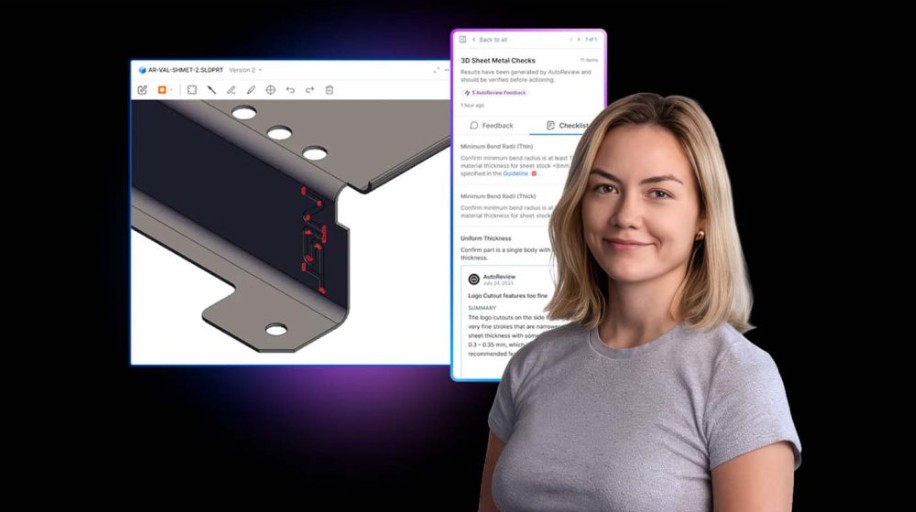
CoLab Software is expanding from its roots in mechanical CAD design review into a broader engineering decision-making platform. In an interview with Develop 3D, chief strategy officer Taylor Young explains how the company is using AI to help engineering teams review increasingly complex product data and collaborate across disciplines.
CoLab describes itself as a design engagement system. Rather than focusing only on formal design reviews, it supports faster, more informal reviews involving CAD models, bills of materials, specifications, and other information engineers use when making decisions.
AI plays a central role through AutoReview, which performs a first-pass assessment of drawings and models. The system checks engineering data against industry standards such as ISO requirements, along with a company’s internal guidelines and lessons learned. This can help engineers apply knowledge that might otherwise remain buried in extensive documentation.
Instead of relying on one large language model, CoLab uses several models for different parts of the review process. One model might be better at interpreting images, while another may perform better with geometry. CoLab can switch between models as their capabilities improve.
The technology is primarily aimed at complex discrete manufacturing, including automotive, aerospace, defense, industrial equipment, heavy machinery, and medical devices. Young also reports growing demand from companies involved in data center development. CoLab integrates with engineering platforms including Creo, NX, Windchill, Teamcenter, and SolidWorks.
The next step is multidisciplinary review. CoLab plans to extend its mechanical engineering capabilities into ECAD and simulation. Engineers could review FEA results, visualize models, examine setup information, and annotate simulation data collaboratively rather than relying on screenshots and presentation decks.
More experimentally, CoLab is exploring ways to launch simple simulations or reruns from its interface. A proof of concept with SimScale demonstrates this approach. The goal is not to replace simulation specialists but to make routine analysis more accessible earlier in design, bringing design and simulation engineers into a more connected decision-making process.
