

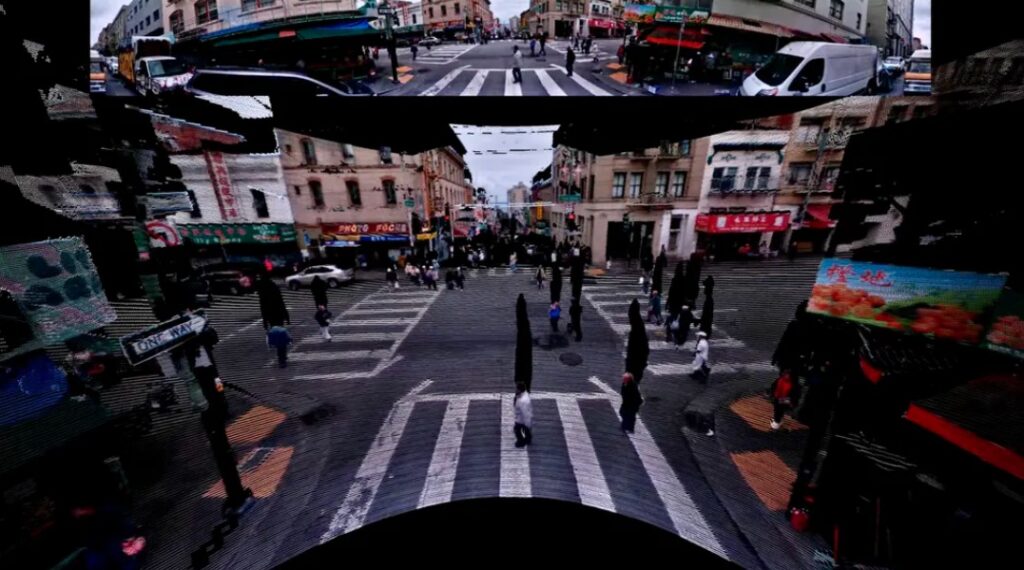
An article in Live Science examines a new LiDAR technology that may significantly improve how robots and self-driving vehicles interpret their surroundings. Developed by researchers at the University of Science and Technology of China, the system is described as the world’s first “native color LiDAR,” capable of capturing full-color 3D images without relying on conventional cameras.
Traditional LiDAR systems work by firing laser pulses and measuring the time it takes for the reflected light to return. This produces highly accurate depth maps that autonomous systems use for navigation and obstacle detection. However, most existing LiDAR units generate only monochrome spatial information, forcing vehicles and robots to combine LiDAR data with separate camera systems to recognize colors, textures, and visual context.
The new system merges those functions into a single sensor. Researchers achieved this by using an optical frequency comb and ultrafast spectral scanning techniques that allow the LiDAR unit to distinguish color information directly from reflected light. The result is a dense, high-resolution 3D representation of an environment in full color. According to the researchers, the technology can detect extremely subtle color differences while maintaining precise depth perception.
The article notes that combining color and depth in one system could improve environmental awareness for autonomous machines operating in difficult conditions such as fog, glare, or low light. Robots could identify objects more accurately, while self-driving vehicles might better distinguish road signs, lane markings, pedestrians, and hazards in real time.
Researchers also suggest the technology could extend beyond transportation into manufacturing, medical imaging, augmented reality, and industrial inspection. Because the system eliminates the need to fuse separate camera and LiDAR streams, it may simplify sensor architectures and reduce computational overhead in autonomous systems.
The development represents a broader trend in sensing technology, where machines are moving beyond simple spatial awareness toward richer environmental perception. As robotics and autonomous mobility continue to advance, color-enabled LiDAR may become an important step toward giving machines a more human-like understanding of the physical world.
