

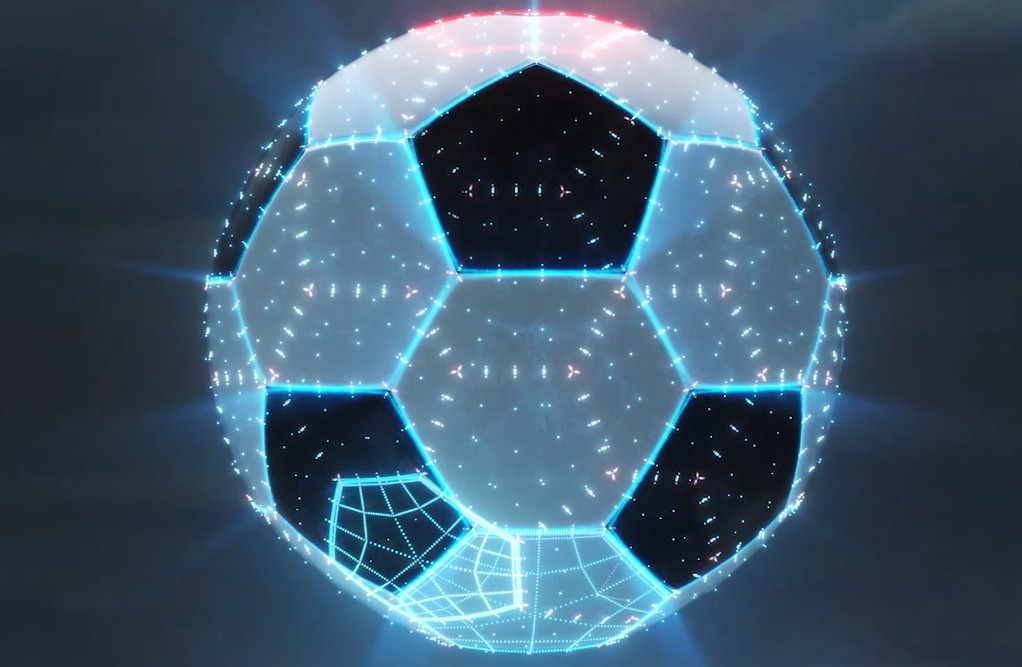
As more than 1.5 billion people prepare to watch the 2026 FIFA World Cup finals, computer vision technology is playing an increasingly important role behind the scenes. FIFA has expanded its use of Sony’s Hawk-Eye system, which supports video assistant referees (VAR), goal-line technology, semi-automated offside detection, and new tools that determine which player last touched the ball before it crosses the boundary line.
According to University of Rochester computer scientist Chenliang Xu, these systems combine multiple computer vision techniques into a sophisticated decision-making platform. Calibrated cameras positioned around the stadium capture live footage, while artificial intelligence models identify players, track the ball, and analyze body positions in real time. The resulting data is then used to alert officials when a review may be necessary.
The technology represents a significant advancement from earlier eras of soccer officiating. Incidents such as Diego Maradona’s infamous “Hand of God” goal during the 1986 World Cup likely would have been detected instantly by today’s systems. Modern computer vision relies on deep neural networks trained on millions of annotated images and videos. These networks learn to recognize players, body parts, and the ball while tracking their movement across multiple camera angles throughout a match.
Sixteen optical tracking cameras are installed in each World Cup stadium. By combining information from multiple viewpoints, the system can reconstruct events in three dimensions, improving depth perception and positional accuracy. This capability is particularly important for offside decisions and determining ball possession.
The speed of these systems comes from their specialized design. Rather than identifying every object in a scene, the algorithms focus only on elements relevant to the game. Advances in deep neural networks and graphics processing units (GPUs) have made it possible to process more than 150 million tracking data points during a single match.
Beyond sports, the same technologies are finding applications in self-driving vehicles, security systems, and large-scale surveillance networks. Yet despite these advances, Xu emphasizes that technology remains a tool rather than a replacement for human judgment. Computer vision can assist with objective decisions, but the drama, emotion, and unpredictability that define the World Cup remain uniquely human.
