

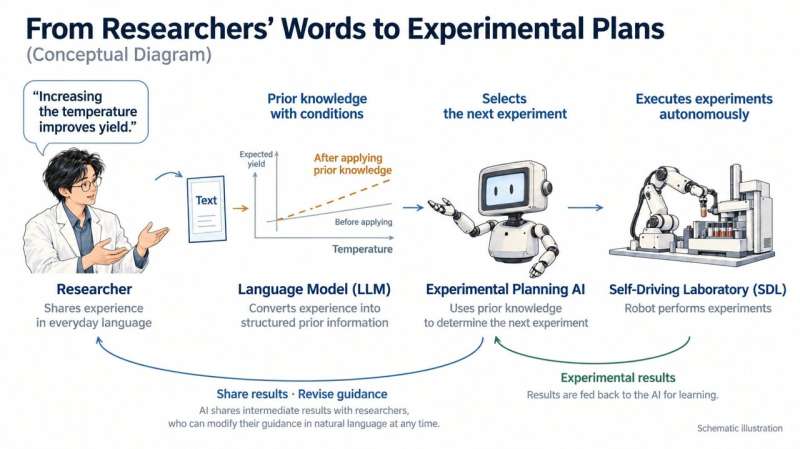
Researchers in South Korea have developed an AI framework that allows scientists to guide self-driving laboratories using everyday language. The system combines large language models with autonomous experimental optimization, potentially reducing the number of experiments required to discover materials, catalysts, and optimal chemical processes, tells Tech Xplore.
Developed by researchers at the Korea Research Institute of Chemical Technology, the human-in-the-loop optimization framework, called HILO, addresses a persistent problem in self-driving laboratories. These laboratories can autonomously select experiments based on previous results, but they often begin without the scientific knowledge researchers have already accumulated. Consequently, the AI may waste time rediscovering known relationships through expensive experiments.
HILO connects a large language model with Bayesian optimization. Scientists can provide guidance in natural language, such as indicating that increasing temperature improves yield or that certain experimental conditions should be avoided. The LLM translates these instructions into structured prior information and constraints that the optimization system can use when choosing subsequent experiments.
Importantly, the framework does not assume that human advice is always correct. An adaptive weight credibility detection mechanism compares expert guidance with incoming experimental data. If evidence increasingly contradicts the guidance, the system disables the unreliable information and returns to data-driven optimization. Tests showed that this capability allowed HILO to recover even when researchers intentionally supplied incorrect advice.
The efficiency gains were substantial in virtual experiments based on real data. For an Ugi multicomponent reaction, reaching target performance required fewer than 10 searches instead of about 30. For conductive P3HT-CNT composites, roughly 20 searches fell to three to five. Researchers estimate the advantage could equal starting with about 40 experimental data points.
The team also released an interactive Co-Scientist interface that lets researchers revise experimental directions through conversation. The next step is validating HILO with physical self-driving laboratory equipment, moving toward laboratories where human expertise and autonomous AI continuously inform each other.
